


















Best Rank Tracking Proxies for 2026: The Complete SEO Guide
In 2026, SEO rank tracking is no longer as simple as typing a keyword into Google. Search results are now hyper-localized and heavily personalized — what a user sees in New York differs from what someone sees in London or Tokyo. For digital marketers and SEO agencies, this creates a massive data-accuracy challenge. Manual tracking is effectively dead. If you want to know where your website truly ranks across different locations and audiences, you need rank tracking proxies. These tools allow you to query search engine results pages (SERPs) at scale without being blocked, fingerprinted, or misled by personalized data.
What Are Rank Tracking Proxies?
A rank tracking proxy acts as an intermediary between your SEO software and the search engine. When your tool sends a ranking query, the proxy conceals your real IP address and replaces it with one from a specific geographic location and device type. The search engine interprets the request as coming from a genuine local user — not an automated scraper.
Traditional manual checks fail for two reasons: they are tied to your browser history and fixed location, both of which introduce significant bias. Proxies eliminate this bias by providing a clean, neutral view of the SERPs every time.
Manual Tracking vs. Proxy-Based Tracking
| Feature | Manual SEO Tools | Rank Tracking Proxies |
|---|---|---|
| Accuracy | Low (biased by cookies, cache, and search history) | High (neutral, localized IPs with no personal data) |
| Scalability | None (limited to a few manual searches) | High (capable of tracking millions of keywords) |
| Block Risk | High (IP bans, CAPTCHAs from repeated queries) | Low (automated IP rotation distributes traffic) |
| Localization | Limited (requires manual VPN switching) | Precise (city, ZIP code, or ISP-level targeting) |
| Mobile vs. Desktop | Difficult to separate reliably | Supported via dedicated mobile proxy pools |
Understanding Proxy Types for SEO Rank Tracking
Not all proxies are created equal. Choosing the wrong type is one of the most common — and most costly — mistakes SEO teams make. Each proxy type has a different trust level, speed profile, and optimal use case.
① Residential Proxies
Residential proxies use IP addresses assigned by real internet service providers to actual home devices. Search engines treat them as regular users, making them the most effective type for rank tracking on Google. The trade-off is cost: residential proxies are typically priced at $2–$8 per gigabyte, and heavy scraping volumes add up quickly. They are the gold standard for local SEO work and any campaign where accuracy matters most.
② ISP Proxies (Static Residential)
ISP proxies are hosted on datacenter infrastructure but registered under real ISP IP ranges. They combine the residential trust score that search engines look for with the performance stability of a datacenter. Because the IP stays consistent over time, ISP proxies are particularly well-suited for tracking core keyword sets where you need a stable baseline for trend analysis — you can compare position data week over week from the same "user" perspective. For operations tracking 500–1,000 keywords daily, 10–20 ISP proxies distributed across target locations is a practical and cost-effective setup.
③ Datacenter Proxies
Datacenter proxies are fast, affordable, and reliable for volume — but their IP ranges are well-known to Google, which aggressively blocks them. Success rates on Google SERPs can drop to 30–50% without additional fingerprinting measures. They remain useful for Bing, Yandex, or Baidu rank tracking, and for non-SERP tasks like site audits or internal link checks where Google's anti-bot systems are not in play.
④ Mobile Proxies
Mobile proxies route traffic through real 4G/5G cellular carrier connections. They are among the hardest IPs for search engines to flag because mobile addresses are assigned dynamically and shared among many real users. Mobile proxies are the best choice for tracking mobile-specific SERPs and for accessing AI-powered search features that rate-limit more aggressively than classic results pages. The downside is cost — mobile proxies typically run $20–$50 per port per month — so they are best reserved for high-value or high-difficulty targets.
Proxy Type Quick-Reference
| Proxy Type | Google Success Rate | Best Use Case |
|---|---|---|
| Residential | 90–99%+ | Local SEO tracking, large keyword sets |
| ISP (Static Residential) | 85–99% | Daily core keyword tracking, trend baselines |
| Datacenter | 30–50% | Bing/Yandex, site audits, non-Google tasks |
| Mobile | 99%+ | Mobile SERP tracking, AI search products |
Why SEO Needs Rank Tracking Proxies in 2026
Keyword rank tracking is much harder than it appears. Google and Bing have spent years perfecting anti-scraping technology. Sending 1,000 keyword queries from a single office IP will result in blocks within minutes. But avoiding blocks is only half the challenge — data accuracy is the real prize, and it requires geo-targeted, unbiased IP addresses.
① The Localization Problem
Search engines use your IP address to determine local intent. A search for "best coffee shop" returns results within a few miles of your location — not a national average. For an SEO agency managing a national or multi-city brand, they need to see those results for dozens of different cities simultaneously. Rank tracking proxies let you "jump" between locations instantly, delivering the exact SERP data that local customers actually see.
② Neutralizing Search Personalization
Your own browsing habits influence your search results. Google tracks which websites you visit frequently and may rank them higher in your personal results — including your own client's site. Proxies deliver a logged-out, history-free view of the SERPs, ensuring the data you report is objective and not distorted by personal behavior.
③ Scaling Without Consequences
Manual tracking breaks down entirely at scale. Tracking 10,000 keywords across 20 cities means 200,000 SERP queries — a volume that is simply impossible without proxy infrastructure and automation. A well-configured rotating proxy pool handles this volume continuously without triggering rate limits or IP bans.
Top 5 Best SEO Rank Tracking Proxies for 2026
Choosing the right provider is critical. The following five providers represent the strongest options available in 2026, spanning enterprise-grade infrastructure to high-value challengers suited for growing agencies. Each has been evaluated on IP pool quality, geo-targeting precision, protocol support, and overall value for SEO rank tracking workflows.
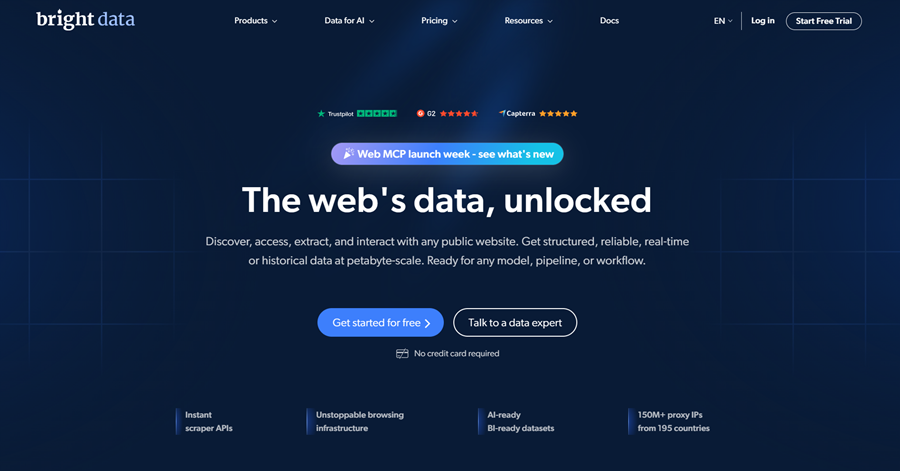
1. Bright Data — Enterprise Standard
- Overview: The longest-established and most feature-rich provider in the industry, trusted by Fortune 500 companies and large data operations globally.
- Key Features: A dedicated SERP API that returns parsed, structured search data; advanced browser automation tooling; ethical IP sourcing with full compliance documentation; support for residential, mobile, ISP, and datacenter proxy types in a single platform.
- Best For: Large SEO agencies, enterprise in-house teams, and developers building custom rank tracking pipelines.
- IP Pool Size: 400M+ IPs.
- Geo-Support: Covering 195 countries and major cities, with ASN-level targeting available.
- Pros: Unmatched infrastructure reliability; broadest feature set; dedicated account management; strong compliance posture for regulated industries.
- Cons: Premium pricing that puts it out of reach for smaller budgets; steep learning curve for teams new to proxy infrastructure.
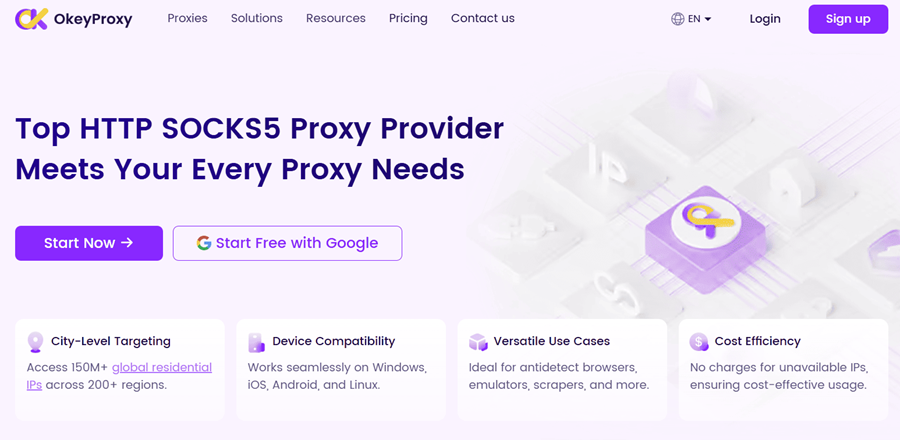
2. OkeyProxy — Best Value for Agencies
- Overview: A fast-growing provider that has earned strong user reviews for its combination of a massive IP pool, competitive pricing, and reliable performance on Google scraping tasks.
- Key Features: 150M+ rotating residential IPs; city and ISP-level geo-targeting across 200+ countries; support for both HTTP(S) and SOCKS5 protocols; a free 1GB trial for new users; 24/7 live support with dedicated account managers.
- Best For: Digital marketing agencies, mid-size SEO teams, and businesses needing a strong balance between performance and budget efficiency.
- IP Pool Size: 150M+ global residential IPs.
- Geo-Support: 200+ countries with precise city and ISP-level targeting.
- Pros: Industry-leading IP pool size for the price point; consistently high Google scraping success rates; flexible rotation and sticky session options; no charges for unavailable IPs; straightforward integration with major anti-detect browsers and scraping tools.
- Cons: Lower brand recognition compared to Bright Data or Oxylabs.
✨ Master your SERP data—Explore OkeyProxy's dedicated [SEO Monitoring] solutions today!
3. Oxylabs — Best for Technical SEO and Developers
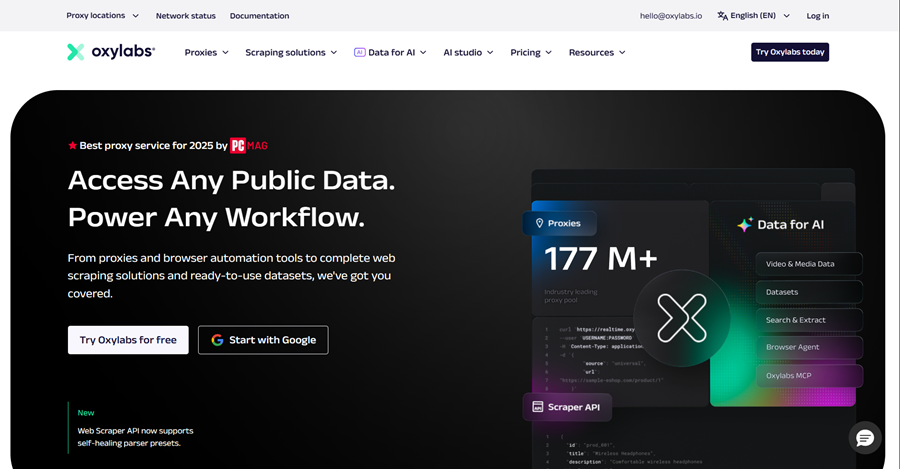
- Overview: A premium enterprise provider with one of the strongest reputations for technical SEO data collection. Cybernews ranked Oxylabs the top overall SEO proxy in 2026, citing its unique combination of pool size, success rate, and dedicated tooling.
- Key Features: A dedicated SERP Scraper API that handles Google's anti-bot countermeasures automatically and returns clean, pre-parsed data; AI-driven CAPTCHA solving; ASN, city, and state-level geo-targeting; next-generation residential proxies optimized for high-frequency scraping.
- Best For: Technical SEO professionals, developers building SaaS rank-tracking products, and high-frequency scrapers who need parsed data delivered reliably at scale.
- IP Pool Size: 177M+ IPs.
- Geo-Support: Wide-ranging geographical coverage, spanning over 195 countries and cities.
- Pros: 99%+ success rate; excellent uptime; dedicated SERP API removes the need to build a custom parsing layer; strong developer documentation.
- Cons: Premium pricing model; overkill for agencies that do not need API-level data delivery.
4. NodeMaven — Best for IP Quality Over Quantity
- Overview: A quality-first provider that prioritizes maintaining a curated pool of high-reputation IPs over raw pool size. NodeMaven actively filters out flagged, low-quality addresses before they reach users.
- Key Features: Pre-filtered, high-reputation residential IPs; built-in fraud-score screening to catch flagged addresses before they reach your scraper; city-level targeting across major global regions.
- Best For: SEO teams that have experienced high block rates with other providers and need a cleaner, more reliable IP pool even if the total pool size is smaller.
- IP Pool Size: 30M+ local IPs.
- Geo-Support: Covering 190+ countries and 1,400+ locations worldwide.
- Pros: Extremely high per-IP success rate; pre-screening reduces wasted requests; straightforward pricing.
- Cons: Smaller pool size limits suitability for very large-scale or high-concurrency operations.
5. IPRoyal — Best for Small Teams and Freelancers
- Overview: A transparent, ethically-sourced proxy provider with flexible pay-as-you-go pricing — making it a natural fit for freelance SEO consultants and small agencies that do not need enterprise-scale infrastructure.
- Key Features: Ethically sourced residential IPs; pay-as-you-go traffic model with credits that generally do not expire; city-level geo-targeting; high concurrency support for efficient parallel data collection.
- Best For: Freelancers, niche site owners, and small SEO teams running cost-efficient multi-location rank tracking.
- IP Pool Size: 32M+ residential proxies.
- Geo-Support: 195+ countries.
- Pros: Affordable entry point; no credit expiry; transparent and ethical sourcing policy; easy-to-navigate dashboard.
- Cons: Pool size can be a limiting factor for operations tracking tens of thousands of keywords simultaneously.
Which provider is right for you? For enterprise teams with large budgets, Bright Data or Oxylabs set the standard. For most agencies seeking the best return on investment, OkeyProxy stands out — a 150M+ IP pool with city-level targeting and competitive pricing is difficult to beat at that price tier. Freelancers and small teams will find IPRoyal's pay-as-you-go model the most flexible starting point.
How to Choose the Right Rank Tracking Proxy
With so many providers available, making the right selection comes down to matching your specific workflow to the right infrastructure. Use the following criteria as your evaluation framework.
① Match Proxy Type to Your Task
For local SEO tracking at city or ZIP-code level, residential proxies are non-negotiable. For tracking a stable core set of keywords over weeks or months, ISP proxies provide the consistent IP identity needed for reliable trend baselines. For mobile SERP tracking, use a mobile proxy pool. Route non-Google tasks through cheaper datacenter proxies to control costs.
② Geo-Targeting Precision
SEO in 2026 is fundamentally local. Country-level targeting is the bare minimum — city-level is standard, and ZIP-code or ISP-level targeting is necessary for hyperlocal campaigns. If your client is a local plumber in Chicago, an IP from New York will return completely different SERP data and make your report meaningless.
③ Automatic IP Rotation
This is a non-negotiable feature. Your proxy should automatically assign a new IP for every request, or at minimum every 5–10 queries. Avoid sending more than one query per IP per minute. Providers with built-in rotation handle this automatically, saving significant configuration time and reducing block risk.
④ Speed and Success Rate
For operations tracking 50,000+ keywords, speed matters. Look for providers with average response times under 0.5 seconds and success rates at or above 99%. At 2% failure, you have 2,000 data gaps in every 100,000 requests — gaps that distort trend lines and undermine client reporting.
⑤ Protocol and Tool Compatibility
Ensure your provider supports both HTTP(S) and SOCKS5. Verify that concurrency limits are sufficient for your peak load — can the provider handle 500 or 1,000 simultaneous requests without degrading performance? Confirm compatibility with your existing SEO tools, scrapers, or anti-detect browsers before committing.
Best Practices: Integrating and Optimizing Your Proxy Setup
Selecting a provider is only the first step. How you configure and use your proxies directly determines the quality of your ranking data.
① Use a Mixed Pool Strategy
The most effective rank tracking setups in 2026 use a tiered proxy architecture rather than a single pool. Use ISP proxies for daily checks on your core keyword set — their stable IPs provide clean baselines for trend analysis. Use rotating residential proxies for broader keyword universe checks and competitor analysis. Reserve mobile proxies for mobile SERP verification and high-security targets. This approach optimizes cost without sacrificing accuracy where it matters most.
② Align User-Agent with Proxy Type
Always set your User-Agent string to match the device type you are simulating. A desktop residential IP sending a mobile browser header is a detectable inconsistency. Matching your User-Agent, viewport settings, and proxy type creates a coherent digital fingerprint that search engines treat as genuine user traffic.
③ Control Request Pacing
High-speed automated requests are a primary detection signal. Space out queries to simulate realistic browsing behavior. Many providers recommend no more than one request per IP per minute for Google. If you begin seeing elevated CAPTCHA rates or 429 errors, slow down your request frequency before switching to a higher-quality proxy pool.
④ Validate Your Data Regularly
Select 20–30 keywords periodically and manually verify their rankings from different devices and browsers. Compare those results against your proxy-scraped data. If average position differences exceed 1–2 places consistently, your proxy setup needs reconfiguration or an upgrade. Also monitor your scraping success rate — anything below 85% for residential proxies or 75% for ISP proxies indicates a problem that is introducing data gaps into your reports.
Rank Tracking Beyond Classic SERPs: AI Search in 2026
The scope of rank tracking has expanded significantly in 2026. Google's AI Overviews, Bing Copilot, ChatGPT Search, and Perplexity now appear prominently in search results — and they behave differently from traditional organic links. Three distinct optimization disciplines have emerged that all require proxy-based monitoring.
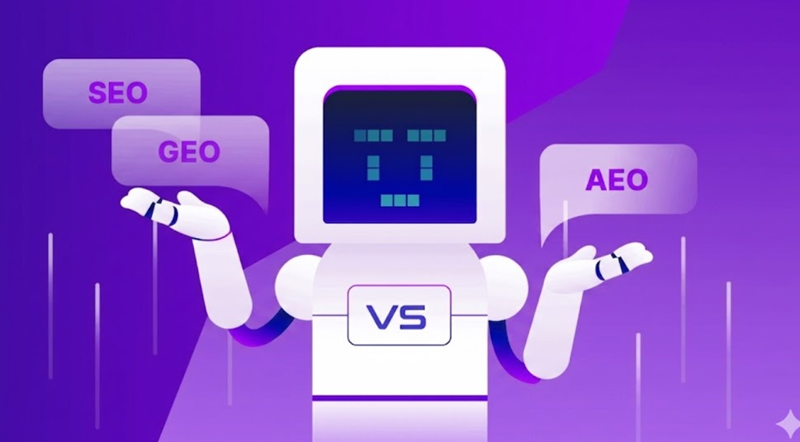
Traditional SEO tracks organic ranking positions in classic SERPs. Answer Engine Optimization (AEO) focuses on being cited or referenced in direct answers from AI assistants such as ChatGPT and Perplexity. Generative Engine Optimization (GEO) targets visibility within AI-generated summaries like Google's AI Overviews and Bing Copilot. All three matter in 2026, and tracking performance across all three requires proxy infrastructure that can handle varied endpoint behaviors.
Google's AI Overviews appear within the standard SERP HTML, so existing residential proxy setups handle them with no additional configuration — you simply parse the AI Overview section from the returned HTML. AI assistants like ChatGPT and Perplexity rate-limit scraping more aggressively than classic SERPs; for these endpoints, rotating residential proxies or mobile LTE proxies with sticky sessions of 10–30 minutes per conversational flow produce the most reliable results.
Practical tip: Always test a small batch of queries first. If you encounter elevated CAPTCHA rates, reduce your request frequency or switch to a higher-trust IP pool. The fastest way to determine whether you need residential or mobile proxies for a specific target is to check block rates empirically on 100 test requests before committing to a full-scale crawl.
Frequently Asked Questions
Can I use free proxies for rank tracking?
No. Free proxies are unsuitable for any serious rank tracking work. Their IP ranges are almost universally blacklisted by Google, their uptime is unreliable, they are shared among large numbers of users (many of whom abuse them), and they pose real security risks to your data. Even budget paid providers represent a significant upgrade in both reliability and safety.
How many IPs do I need to track 10,000 keywords?
You do not need 10,000 individual IPs. A rotating residential proxy pool of a few thousand IPs can handle tens of thousands of daily requests if requests are properly paced. For stable daily tracking of a core keyword set, 10–20 ISP proxies distributed across your target locations is a practical starting point. Scale up to a larger rotating pool as your keyword volume grows.
Does using a proxy slow down my SEO tools?
A high-quality proxy adds minimal latency — typically milliseconds. The far more significant effect is positive: proxies allow you to run hundreds of parallel requests simultaneously, making the total time to complete a large keyword report dramatically shorter than any single-IP approach could achieve.
Do I need separate proxies for mobile and desktop rank tracking?
For most operations, rotating residential proxies with appropriate User-Agent headers adequately simulate both mobile and desktop users. However, if mobile SERP accuracy is critical to your campaigns — for example, tracking rankings in mobile-heavy markets — a dedicated mobile proxy pool will deliver more authentic results, since mobile carrier IPs are significantly harder for search engines to flag than residential IPs.
Are rank tracking proxies legal?
Using proxies to query publicly accessible search engine results pages is generally legal in most jurisdictions. However, it may conflict with the terms of service of specific platforms. Always consult your legal counsel if you operate in regulated industries, and choose providers with clear ethical sourcing policies and acceptable-use documentation.
Conclusion
Accurate ranking data is the foundation of every effective SEO strategy. Without rank tracking proxies, you are working with personalized, geographically biased data that misrepresents how your target audience actually experiences search results. In the hyper-localized, AI-influenced search landscape of 2026, these tools are no longer optional infrastructure — they are a core requirement for any professional SEO operation.
Whether you choose an enterprise solution or a high-value provider like OkeyProxy, prioritize IP quality, geo-targeting precision, and a proxy type matched to your actual workflow. Start with a tiered setup — ISP proxies for your core keywords, rotating residential for broader research — and validate your data regularly against manual checks. Build on that foundation, and your ranking reports will be accurate, your client accounts will remain safe, and your strategy decisions will be grounded in data that reflects reality.
