
















How to Make a New Instagram Account After Being Banned
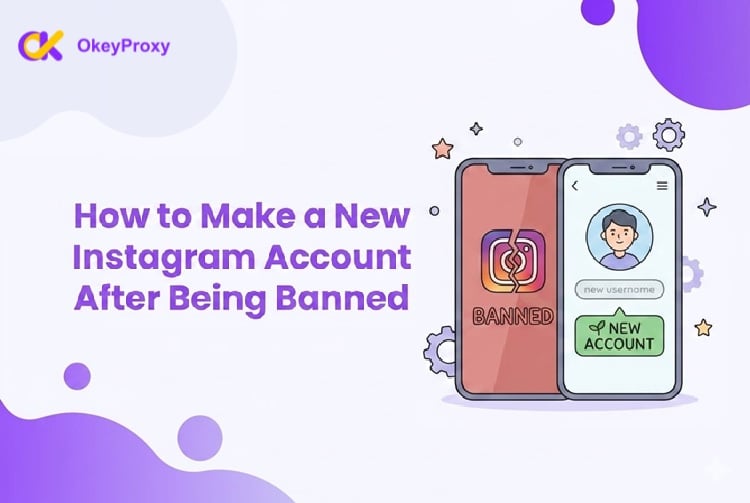
Getting banned on Instagram is frustrating enough. But the real nightmare begins when you create a new profile — and it gets disabled within minutes. Sound familiar? You're not alone. This "insta-ban loop" is one of the most common problems users face in 2026, and it happens because Instagram hasn't just banned your username — it's banned your entire digital identity.
The good news? There's a way out. If you want to know how to make a new Instagram account after being banned and actually keep it, you need to understand exactly what Instagram is tracking — and then change all of it. This guide walks you through every step, from identifying your ban type to building a bulletproof new account from scratch.
Step 0: Know Your Ban Type Before You Do Anything
Before jumping into creating a new account, take a breath. Not all Instagram bans are permanent — and if yours isn't, you might be able to recover your original account through official channels. Here's a quick breakdown of ban types and what they mean for you:
| Ban Type | What Happens | Duration | Can You Appeal? |
|---|---|---|---|
| Action Block | Specific actions (likes, follows, DMs) are restricted | 24 hours – 30 days | Yes (wait it out or appeal) |
| Shadowban | Your posts become invisible to non-followers; no notification | 2–14 days typically | No — stop triggering behavior and wait |
| Temporary Suspension | Account disabled pending review; profile hidden | Days to 180 days | Yes — use the in-app Appeal button |
| Permanent Ban | Account deleted; all content removed | Permanent | Rarely — only if the ban was clearly an error |
| IP Ban | Your entire network is blocked; all accounts affected | Indefinite | No — requires a new IP address |
Try the Official Appeal First
If Instagram shows you an "Appeal" button when you try to log in, use it. Fill out the form honestly, use your real name, explain the situation calmly, and submit a selfie verification if prompted. You may need to wait a few days for a response — but recovering your original account is always better than starting from zero.
Only move on to creating a new account if your ban is confirmed permanent, or if the appeal has been rejected. Ready? Let's get into it.
Why Does Instagram Keep Banning Your New Accounts?
Here's what most people don't realize: Instagram's security AI doesn't just ban your username. It bans a whole fingerprint of who you are online. When you create a new account and get banned within minutes, it means their system recognized you before you even posted anything. Here are the four ways they catch you.
1. Hardware ID (IMEI / Serial Number) 📱
Every smartphone and computer has a unique hardware fingerprint — your IMEI number, serial number, and MAC address. Instagram logs these identifiers when a ban occurs. If you log into a new account on the same physical device without a deep reset, the platform knows it's you before you even choose a username. To Instagram, the "person" hasn't changed; only the profile name has.
2. IP Address Reputation 🌐
Your home Wi-Fi has a public IP address. If you were banned while connected to your home network, that IP is now red-flagged in Meta's systems. Any new account created or accessed from that same connection faces extreme scrutiny — sometimes getting auto-disabled within seconds of registration. Simply restarting your router may not be enough, since many ISPs use semi-static IP addresses that rarely change.
3. Cookies, Cache, and Metadata 🍪
Think deleting the Instagram app clears everything? Unfortunately, no. Hidden "ghost" data often lingers in your phone's deep storage and browser cache. These metadata breadcrumbs allow Instagram's algorithm to connect your old banned session to your fresh new attempt — even if you've created a completely new account and email address.
4. Linked Personal Information 🔗
This is the most common mistake people make. Using the same phone number, a nearly identical username, or the same profile photo is essentially waving a flag that says "it's me again." Instagram's AI is sophisticated enough to use facial recognition on profile photos. Upload that same selfie from your banned account and the system will automatically flag you for ban evasion.
Preparation: What You Must Change Before Starting
There are no shortcuts here. To successfully learn how to make a new Instagram account after being banned, you need to replace every element that could link you to your old account. Think of it as creating an entirely new digital person — not just a new username.
- New Device (or Full Factory Reset): A simple app uninstall does nothing. Instagram has already logged your device's hardware fingerprint. You need a device it has never seen before.
- New Network / Clean IP Address: Your home Wi-Fi is compromised. Stop using it — and stop using the mobile data plan that was active during your ban. You need a completely fresh IP address.
- New Identity Details: Create a brand-new email address (Gmail or Outlook work well). Get a new phone number that has never been linked to Instagram. Avoid VoIP or virtual numbers — Instagram blocks most of them during verification.
- New Creative Assets: Every single image, video, bio sentence, and even your writing style should be original. Do not copy and paste anything from your old account — not even your bio description.
Got everything ready? Good. Now let's walk through the actual setup process, step by step.
Step-by-Step: Creating a Bulletproof New Instagram Account
Follow these steps in exact order. Skipping even one can trigger another ban before you've posted a single photo.
Step 1: Deep Clean Your Hardware 🧼
The safest option is to use a different phone or a brand-new laptop that has never accessed Instagram. If that's not possible and you must use the same device, perform a full factory reset — not just a cache clear.
Critical warning: Do not restore from a cloud backup (iCloud, Google Drive, Samsung Cloud, etc.). Restoring from backup re-imports the exact cookies, stored credentials, and device associations that got you banned in the first place. Set the phone up as a completely new device.
Step 2: Secure a Residential IP Address 🏠
This is the single most important step in the entire process. You cannot simply toggle on a VPN and call it done — Instagram actively detects and blocks most VPN datacenter IPs in 2026. What you need is a residential IP address: an IP that belongs to a real home user, in a real location, that looks completely legitimate to Instagram's security filters.
OkeyProxy's Residential Proxy Network gives you access to over 150 million clean residential IPs from real devices worldwide. When you connect through OkeyProxy, Instagram sees a legitimate new user from a new location — not a red-flagged datacenter IP or a recycled VPN address. It's the most reliable way to break the IP link between your old banned account and your new one.
Step 3: Clear All Residual Data 🧹
Before you even open a browser or the Instagram app, clear everything:
- On a phone: go to Settings → Apps → Instagram → Clear Data
- On a browser: clear your full history, cookies, and cached files — not just for Instagram, but for all sites
- On a computer: consider using a fresh browser profile or a clean incognito window for the initial sign-up
You want Instagram to encounter a completely blank slate — zero cookies, zero history, zero recognition.
Step 4: Register Through the Browser First 📝
When you're ready to sign up, don't start in the Instagram app. Instead, open a clean desktop browser (Chrome Incognito works fine) while connected through your residential proxy. Register using your brand-new email address and your new phone number for verification.
Completing the initial registration via web browser, rather than the app, tends to trigger fewer automated security checks. Once the account is confirmed, then install the app and log in.
Step 5: Build a Completely New Identity 👤
Be genuinely creative here. If your old handle was @BakerJohn, don't use @BakerJohn2 or anything close to it. Choose a new profile photo (not a selfie from your old account — Instagram's image recognition can flag it). Write a fresh bio in a different style. Even if you run the same type of content, approach it from a new angle.
Step 6: Warm Up the Account — Slowly 🐢
Your account is live. Now resist every urge to go full throttle immediately. For the first 24 hours, just browse — watch Reels, use the search bar, like a post or two from a major account. Let the algorithm see you as a real human being who's just discovered the app. We'll cover the full warm-up strategy in a dedicated section below.
Proxy vs. VPN: Which One Actually Works?
Most people's first instinct is to grab a VPN. It's an understandable move — but in 2026, it's often the wrong one. Meta has become very good at identifying VPN traffic, particularly from datacenter-based VPN services where thousands of users share the same IP pool. Here's a direct comparison:
| Feature | Standard VPN | Residential Proxy (e.g., OkeyProxy) |
|---|---|---|
| Detection Risk | Very High — shared datacenter IPs are widely blacklisted | Extremely Low — routes through real home user IPs |
| Stability | Moderate — frequently triggers CAPTCHAs and login challenges | Very High — smooth, uninterrupted browsing experience |
| Fingerprint Isolation | Weak — only masks IP, not device fingerprint | Strong — especially when paired with browser isolation tools |
| Instagram Compatibility | Frequently blocked on registration and login | Passes Instagram's network checks reliably |
| Overall Rating | ⭐⭐ | ⭐⭐⭐⭐⭐ |
The bottom line: a VPN changes your IP, but it gives you an IP that Instagram already mistrusts. A residential proxy from OkeyProxy gives you an IP that looks exactly like any other new user logging in for the first time — because it essentially is one.
The Professional Secret: Anti-Detect Browsers for Multiple Accounts
If you're a marketer, agency, or creator managing more than one Instagram account, performing a factory reset for every profile isn't realistic. This is exactly what anti-detect browsers are built to solve.
How Anti-Detect Browsers Work 🛠️
Tools like AdsPower or Multilogin let you create hundreds of isolated "virtual devices" on a single screen. Each browser profile has its own unique device fingerprint, cookie store, timezone, language settings, and screen resolution. To Instagram, each profile looks like a completely different user on a completely different phone in a completely different city.
When you pair an anti-detect browser profile with a dedicated Residential SOCKS5 Proxy from OkeyProxy, each account becomes fully isolated and undetectable. This is the industry-standard approach for anyone running Instagram accounts at scale in 2026 — whether that's for clients, e-commerce, or content operations.
The Warm-Up Phase: Don't Get Banned Again in 48 Hours
The first 48 hours are the most dangerous window for any new Instagram account. The algorithm watches new profiles closely for bot-like behavior patterns. If you move too fast, you'll find yourself back at square one. Follow these rules to survive — and thrive — in the warm-up phase.
Day 1 — Just Browse
- Watch Reels naturally, as a real person would
- Use the search bar to explore topics you're genuinely interested in
- Like 2–3 posts from popular, established accounts
- Add your profile photo and write a simple, short bio
- Do not include any website URL in your bio — links are a high-risk trigger for brand-new accounts
- Do not follow more than 5–10 accounts on day one
Days 2–7 — Gradual Activity
- Limit follows to 10–20 per day, increasing slowly over the week
- Engage with comments authentically — generic comments like "great post!" can look automated
- Post your first piece of content (a single photo or Reel) — original content only
- Keep likes under 150 per hour; Instagram's own limits treat exceeding this as spam behavior
Days 7–14 — Build Trust
- Enable Two-Factor Authentication (2FA) — this signals account legitimacy and boosts your "trust score" with the algorithm. Use an authenticator app like Google Authenticator, not your old phone number.
- You can now add a bio link if relevant to your content
- Begin a consistent posting rhythm — 3 to 5 times per week is sustainable without looking suspicious
- Wait at least 14 days before running any paid ads. And if you do run ads, never use a payment method linked to a banned account — use a completely new card or payment method
Golden rule of the warm-up phase: Act exactly like someone who has just discovered Instagram for the first time. Because as far as the algorithm is concerned, that's exactly who you should be.
How to Avoid a Shadowban on Your New Account
Getting the account live is step one. Keeping your content visible is step two. A shadowban is Instagram's quiet way of limiting your reach — your posts stop appearing in hashtag results or on the Explore page, but you're not notified and the account stays active. You'll notice it as a sudden, unexplained drop in engagement and follower growth.
Here's how to keep your new account clean:
- Never use banned hashtags. Search any hashtag before using it. If the search shows "Recent posts for #[tag] are hidden because some posts may not follow Instagram's Community Guidelines," that hashtag is banned. One banned hashtag can restrict an entire post's visibility.
- Rotate your hashtags. Using the same 15 hashtags on every post looks spammy. Vary them based on content. Aim for 5–10 highly relevant hashtags per post rather than a wall of generic ones.
- Don't log into banned accounts on the same device. If you ever access your old banned account on the same phone where your new account lives, Instagram can link the two. If one gets flagged, the other may follow.
- Avoid automation tools. Third-party tools that auto-like, auto-follow, or auto-comment are the single most documented cause of shadowbans in 2026. Instagram's detection for these has become extremely accurate.
- Post original content consistently. The algorithm rewards accounts that post regularly, get genuine engagement, and stay within a defined content niche. Saves and shares matter more than likes — create content worth bookmarking.
⚠️ Important: Shadowbans typically lift within 2–14 days if you stop the triggering behavior. But repeated violations can lead to permanent restrictions. When in doubt, slow down and post less — not more.
Frequently Asked Questions
Q: Can I link my new account to the same Facebook account?
A: Absolutely not. Your Facebook account is part of Meta's interconnected identity system. If your Instagram was banned, the linked Facebook profile is almost certainly flagged as well. Connecting them will trigger an instant ban on your new account.
Q: Will a factory reset actually remove the device ban?
A: In most cases, yes — a factory reset clears the local storage and software identifiers that Instagram tracks. However, on some Android devices, the hardware IMEI number remains a risk factor even after a reset. For a fully clean slate, using a different device (or combining a reset with a residential proxy) is the safest approach.
Q: Why was my new account banned within minutes of creating it?
A: You left a digital footprint. The most common causes are: using the same Wi-Fi network, using the same device without a complete reset, or reusing a piece of information (phone number, photo, email pattern) linked to your old account. Instagram's automated systems are fast — they flag ban-evading accounts before you've made a single post.
Q: How do I fix a banned IP address?
A: You can't easily "unban" an IP from Instagram's systems. The most reliable solution is to use a Residential Proxy — it gives you a legitimate, clean IP address from a real home network, without needing to contact your ISP or change locations. OkeyProxy is built exactly for this use case.
Q: How long should I wait before running Instagram ads?
A: Wait a minimum of 14 days. Ads require a payment method — and if that payment method was ever linked to a banned account, Instagram will flag you immediately. Use a completely new card or payment method, and let the account establish a trust history first.
Q: Can Instagram detect accounts created on the same device?
A: Yes. Instagram tracks multiple account logins across devices, IP addresses, and browser environments. If one account on a device gets flagged, others on the same device can be affected too — a phenomenon known as a "chain ban." This is why using an anti-detect browser with isolated profiles is so valuable for anyone managing more than one account.
Q: Is there an official way to check if I'm shadowbanned?
A: Instagram doesn't offer an official shadowban checker. The best DIY method: post something with a unique, low-traffic hashtag (like your username + a random word), then ask a friend who doesn't follow you to search that hashtag. If your post doesn't appear, your account may be shadowbanned. You can also monitor your Instagram Insights for sudden drops in reach from non-followers.
Summary: The One Word That Decides Everything
Learning how to make a new Instagram account after being banned comes down to a single concept: Isolation. Your new digital identity must be completely isolated from your old one — different device (or factory-reset device), different IP address via a residential proxy, different phone number, different email, different content.
Cut every thread connecting the old you to the new you, and Instagram has nothing to flag. Leave even one thread intact, and their AI will find it within minutes.
Here's your quick-reference checklist before you start:
- ✅ Confirm your ban is permanent (or appeal has failed)
- ✅ Factory reset your device — or use a new one
- ✅ Set up a residential proxy (OkeyProxy) for a clean IP
- ✅ Create a new email address and phone number
- ✅ Register through the browser first, then install the app
- ✅ Build a completely new identity — no recycled photos, bios, or usernames
- ✅ Follow the 14-day warm-up protocol
- ✅ Enable 2FA on day 7–14
- ✅ Avoid automation tools and banned hashtags
Don't let a past mistake define your digital future. Reset everything, secure a clean residential IP with OkeyProxy, and start building again — the right way.
