


















What Is a Sticky Session? How Session Persistence Works & Why It Matters
Imagine this scenario. You are shopping online for a brand new laptop. You spend twenty minutes researching specs, reading reviews, and comparing prices. Finally, you find the perfect model and click "Add to Cart." You decide to click over to the next page to find a nice protective sleeve for it. But when the new page loads, your shopping cart is completely empty — and the website has logged you out entirely. You have to type your password again and start your search from scratch.
What exactly went wrong? In most cases, the website's load balancer silently routed your second request to a different backend server — one that had no record of your cart or your login. This is exactly the problem that sticky sessions were designed to solve.
What Is a Sticky Session?
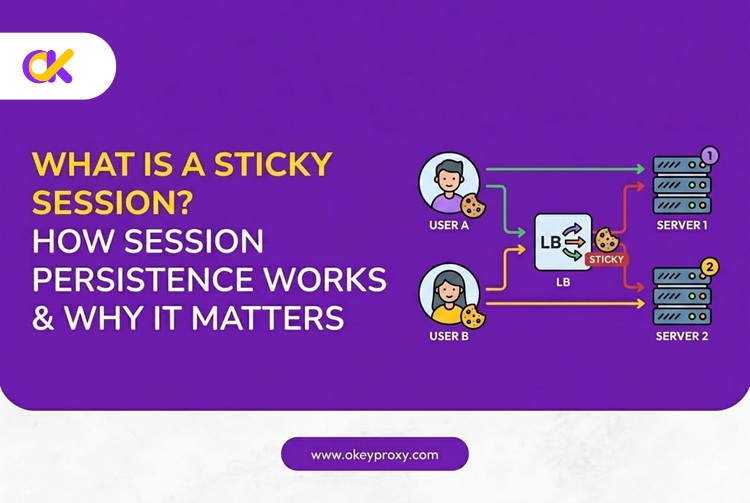
A sticky session — also known as session persistence or session affinity — is a load balancing technique that ensures all web requests from a specific user are consistently directed to the same backend server for the entire duration of their visit. Rather than bouncing you between different servers at random, the load balancer "sticks" your browser to one machine, so your login state, shopping cart, and in-progress actions are preserved seamlessly from click to click.
To picture how this works, think of a busy restaurant kitchen with ten chefs working simultaneously. A manager at the front door hands each incoming order to whichever chef is available. Under normal conditions, your appetizer, main course, and dessert might each go to a different chef — with predictably chaotic results. Sticky sessions are the equivalent of telling that manager: "Once a table is assigned to Chef A, every course for that table goes to Chef A, no exceptions."
In networking terms, that front-door manager is the load balancer. Activating session persistence changes the load balancer's behavior: instead of distributing your next request randomly, it remembers your assigned server and routes you back there every time.
Why Do Websites Need Sticky Sessions?
To understand why sticky sessions matter, you first need to understand a fundamental rule of the internet: HTTP is a stateless protocol. Stateless means that every individual HTTP request is completely independent. A web server has no built-in memory of what you did one second ago. Each click is treated as if it is your very first visit.
Sticky sessions solve this "digital amnesia" by locking your browser to a single server, giving that server a consistent picture of your activity throughout your visit. Here are the most common scenarios where session persistence is essential:
- Maintaining Shopping Carts: Without session affinity, your next click could go to a server that has no record of the items you just selected, leaving your cart empty.
- Keeping Users Logged In: Session data like authentication tokens is often stored in the server's local memory. Routing you to a different server mid-visit means that server has no idea you're logged in.
- Real-Time Web Gaming: Multiplayer browser games require instant state updates. Routing your game data to the same server keeps player positions, scores, and physics perfectly synchronized without lag.
- Preserving Application State: Multi-step forms, file uploads, and active customer support chats all depend on a consistent server-side state. A mid-task server switch can corrupt or lose that progress entirely.
- High-Security Financial Sessions: Banking and payment systems track sessions for fraud detection. If your connection suddenly jumps to a different server mid-transaction, the security system may flag it as suspicious activity and freeze your account.
Editor's Tip: If your platform allows users to upload large files — think video platforms or cloud storage services — sticky sessions are especially critical. A large upload being processed on Server A will fail immediately if the load balancer reroutes the user to Server B midway through.
How Does a Sticky Session Work?
The mechanism behind sticky sessions is straightforward: the load balancer assigns each user a unique tracking tag on their very first request, and reads that tag on every subsequent request to route them back to the correct server.
There are two primary methods load balancers use to implement this:
① Cookie-Based Persistence (Most Common)
When your browser visits a site for the first time, the load balancer picks an optimal backend server — let's call it Server A. Before forwarding your request, the load balancer inserts a small tracking cookie into your browser. For every subsequent click, your browser automatically sends that cookie, and the load balancer reads it to route you straight back to Server A.
Cookie-based persistence comes in two flavors:
- Duration-based: The load balancer issues its own cookie with a fixed expiration time. When that time runs out, the session is no longer sticky and you may be reassigned to a different server.
- Application-controlled: The application itself generates the session cookie, and the load balancer respects whatever expiration time the application specifies. This approach gives developers finer control but requires closer coordination between the app and the load balancer.
② IP-Based Persistence
Instead of using cookies, the load balancer reads the user's IP address and always routes requests from that IP to the same backend server. This method requires no client-side storage, but it breaks down in situations where multiple users share a single IP (e.g., users behind a corporate NAT) or when a user's IP changes mid-session (e.g., mobile networks).
The Step-by-Step Workflow
- First Request: Your browser contacts the website for the first time. The load balancer receives the request and assigns it to Server A.
- Tagging: The load balancer inserts a session cookie (or notes your IP) to remember your server assignment.
- Routing: Every subsequent request you make includes that cookie. The load balancer reads it and routes you directly back to Server A.
- Session End: When the cookie expires or you close the browser, the session ends. Your next visit may be assigned to a different server.
Sticky Session vs. Non-Sticky Session: A Direct Comparison
Is sticky session always the right choice? Not necessarily. Every architectural decision involves trade-offs. Here's how the two approaches stack up across the dimensions that matter most:
| Feature | Sticky Session | Non-Sticky Session |
|---|---|---|
| Load Distribution | Can be uneven. Active users may pile onto one server while others sit idle. | Perfectly even. Traffic spreads across all available servers on every request. |
| Session Data Sync | Not needed. Session data lives on one server; no inter-server sharing required. | Mandatory. All servers must query a shared central store for session data. |
| Fault Tolerance | Weak. If your assigned server crashes, your active session data is lost. | Strong. Any server can pick up the request if another goes down. |
| Scalability | Limited. New servers only receive new sessions; overloaded servers stay overloaded until sessions expire. | High. New servers immediately absorb traffic from the full request pool. |
| Implementation Complexity | Simple. Most load balancers support it out of the box with minimal configuration. | Complex. Requires distributed databases (Redis, Memcached) or token-based auth. |
| Best Suited For | Stateful apps, legacy systems, smaller-scale deployments, file upload platforms. | Stateless microservices, CDNs, API gateways, high-scale cloud applications. |
Known Limitations of Sticky Sessions
Sticky sessions are a well-proven tool, but they come with several trade-offs that engineers need to plan for before deploying them:
- Uneven Load Distribution: When heavy users get pinned to the same server, that machine can become a hotspot while others remain underutilized — partially defeating the purpose of load balancing.
- Poor Failover: If your assigned server goes offline, all session data stored on it is lost. Users experience an abrupt logout and lose their in-progress work.
- Horizontal Scaling Delays: When you add new servers to handle traffic spikes, existing users remain pinned to their original servers. New servers only absorb brand-new sessions, so overloaded servers stay overloaded until current sessions expire.
- IP-Based Limitations: If you rely on IP tracking rather than cookies, users behind shared IPs (corporate offices, university networks) may all get pinned to the same server simultaneously, creating an artificial bottleneck.
- DDoS Vulnerability: Because sticky sessions concentrate users on specific servers, a targeted denial-of-service attack is more likely to knock out a large segment of active users at once.
Sticky Sessions in Proxy Networks: A Critical Use Case
Sticky sessions are not just a web development concept — they play an equally critical role in the world of proxy services and internet automation. If you use proxies for business data gathering, social media management, or e-commerce operations, understanding sticky proxy sessions can completely transform the reliability of your workflows.
① Web Scraping and Automated Data Collection
When gathering public data from sophisticated websites, you often need to navigate through multiple pages, log into portals, or complete multi-step search forms. If your proxy server rotates your IP address on every single request, the target site's security systems will immediately detect it as anomalous behavior. The site flags your connection as bot traffic, serves up endless CAPTCHAs, or blocks your access entirely. A sticky proxy session keeps your outbound IP address consistent throughout your entire data-gathering sequence, making your automated requests look indistinguishable from those of a real human user browsing normally.
② Multi-Account and Social Media Management
Managing multiple storefronts, ad accounts, or social media profiles requires absolute IP consistency. If a platform sees your business account log in from New York on one request and London on the next, it will trigger an immediate fraud alert and restrict or ban your accounts. Sticky proxy sessions guarantee that your IP address and server node stay completely fixed for the full duration of each task — perfectly mimicking the behavior of a single person sitting at a home computer.
The Right Tool for the Job: OkeyProxy
When your business operations demand rock-solid session persistence, low-grade public proxy lists simply won't cut it. You need a professional-grade infrastructure built specifically for long-running, high-stakes workflows. This is where OkeyProxy stands apart as a proven market leader.
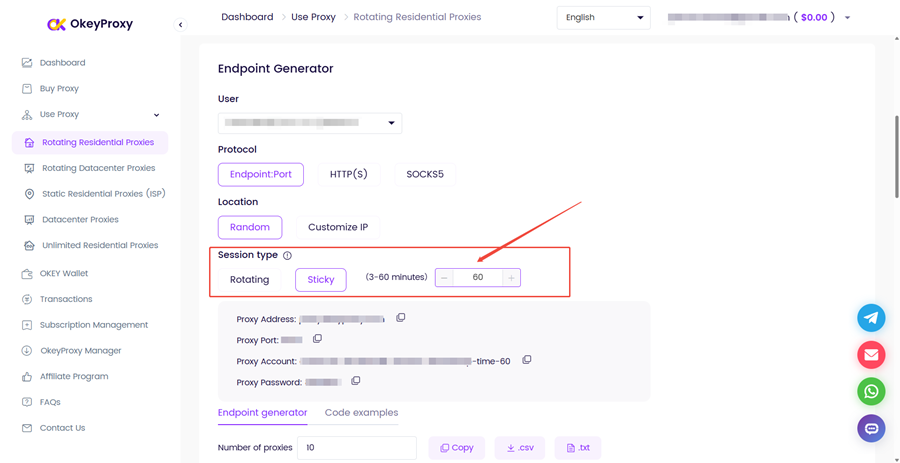
OkeyProxy's Rotating Residential Proxies come with built-in sticky session support, giving you the flexibility and reliability serious business operations demand:
- Flexible Sticky Session Control: In the proxy dashboard, simply set the Session Type to Sticky and choose a duration between 3 and 60 minutes. For the entire selected window, your outbound IP address stays completely fixed — no unexpected rotations mid-task.
- Significantly Higher Success Rates: Optimized routing infrastructure combined with clean residential IP sourcing translates directly to fewer blocks, fewer CAPTCHAs, and more reliable data collection compared to datacenter alternatives.
- Built for Continuous Heavy Workloads: Whether you are running market monitoring, large-scale competitive intelligence, or multi-platform account operations, OkeyProxy's infrastructure is engineered for uptime and stability under sustained load.
If you are tired of unexpected connection drops, mid-session IP changes, and constant anti-bot blocks derailing your workflows, it is time to upgrade. Try OkeyProxy today and give your automation the session stability it deserves.
Modern Alternatives to Sticky Sessions
As cloud-native architectures have matured, many modern applications have moved away from traditional sticky session models in favor of stateless designs that store session data externally. This lets any server handle any user request at any time — removing the single-server dependency that makes sticky sessions fragile at scale.
① Distributed Session Stores (Redis / Memcached)
Instead of storing your cart or login state inside a single server's memory, all servers in the cluster share access to a centralized, ultra-fast in-memory database like Redis or Memcached. When you click to a new page and land on Server B, Server B simply queries the shared store, retrieves your session data in milliseconds, and serves your page seamlessly. If one server goes offline, your session data survives safely in the central store.
② Token-Based Authentication (JWT)
JSON Web Tokens (JWT) eliminate server-side session storage entirely. When you log in, the server verifies your credentials and issues a signed, encrypted token. That token lives in your browser. On every subsequent request, your browser presents the token to whichever server receives the request. The server validates the signature cryptographically — no shared database lookup required. Any server in the cluster can authenticate you instantly, making this approach perfectly suited to elastic, auto-scaling cloud architectures.
③ Consistent Hashing
Consistent hashing is a computation-based alternative to cookie tracking. The load balancer extracts a stable property of the incoming request — typically the client IP or a user ID — and runs it through a deterministic algorithm that always maps the same input to the same server. Unlike IP-based stickiness, consistent hashing handles server pool changes more gracefully: when a server is added or removed, only a fraction of users need to be remapped rather than the entire pool.
When Should You Use Sticky Sessions?
Sticky sessions are the right choice when your application stores meaningful state in a server's local memory and you need the simplest possible implementation. Specifically, they are well suited for:
- Legacy monolithic applications not designed for stateless operation
- Platforms handling large file uploads that must complete on the same server
- Small-to-medium deployments where horizontal scaling demands are predictable
- Proxy networks requiring long-duration IP consistency for automation workflows
They are a poor fit for high-scale stateless APIs, content delivery networks, or any architecture where horizontal auto-scaling is a core requirement.
Conclusion
Strip away the jargon and the answer to what is a sticky session is simple: it is the internet's reliable method for making a cluster of independent servers feel like a single, personalized experience. By binding your browser to one specific backend server, session persistence ensures you never lose your login, your cart, or your progress mid-visit.
Whether you are an engineer configuring a load balancer for a production application or a business professional running automated workflows through a proxy network, session stability is the foundation of a seamless user experience. And when you need that stability at scale — with the ability to lock your IP address for up to 60 minutes per session — OkeyProxy's Rotating Residential Proxies with Sticky Session support are the professional-grade tool built for exactly that job.
