


















Why Use Proxies for Google Ads Verification in Taiwan
Ad verification is critical for ensuring Google Ads campaigns in Taiwan perform as intended, comply with regulations, and reach the right audience without fraud.
Using proxies for ad verification addresses specific challenges unique to Taiwan’s digital advertising landscape, such as geographic restrictions, anti-bot measures, and regulatory compliance.
Below, we outline the need for proxies in ad verification, the issues they resolve, and how solutions like OkeyProxy provide a reliable way to achieve accurate, fraud-free campaign insights.

Why Proxies Are Needed for Ad Verification in Taiwan
1. Geo-Targeted Accuracy
Taiwan’s advertising ecosystem relies heavily on precise geographic targeting to deliver ads tailored to local users. Without a Taiwanese IP address, advertisers cannot verify how ads appear to local audiences, as Google customizes ad placements based on user location. Proxies provide Taiwanese IPs, allowing advertisers to simulate local user behavior and confirm ad visibility, placement, and relevance.
2. Bypassing Google’s Anti-Bot Measures
Google employs sophisticated algorithms to detect automated scraping or repetitive requests, often flagging non-human behavior with CAPTCHAs or IP bans. Verifying ads at scale requires multiple requests, which increases the risk of detection. Residential proxies, which use IP addresses assigned by ISPs, mimic real user activity, reducing the likelihood of being flagged and ensuring uninterrupted verification.
3. Regulatory Compliance
Google has enforced strict verification requirements for advertisers promoting financial services in Taiwan, mandating authorization from bodies like the Financial Supervisory Commission. Proxies enable advertisers to verify that ads align with these regulations by simulating local user perspectives, helping avoid disapprovals or account suspensions due to non-compliance.
4. Ad Fraud Prevention
Taiwan’s digital market is not immune to global ad fraud, estimated to cost advertisers $100 billion annually. Fraudulent activities like bot-driven clicks or hidden impressions can skew campaign performance. Proxies allow advertisers to monitor ad placements anonymously, detecting anomalies and ensuring ads reach genuine audiences.
5. Competitor Analysis
Understanding how competitors’ ads are displayed in Taiwan provides strategic insights for optimizing campaigns. Proxies enable advertisers to view competitor ads as a local user would, revealing details about ad formats, placements, and targeting strategies without detection.
Key Issues in Ad Verification Without Proxies
Without proxies, advertisers face significant challenges that hinder effective ad verification in Taiwan:
1. Geographic Restrictions
Ads are often tailored to Taiwan’s local market, including language, cultural nuances, and regional preferences. Without a local IP, advertisers may see irrelevant or incorrect ad versions, leading to inaccurate campaign assessments.
2. IP Blocking and CAPTCHAs
Repeated requests from a single IP trigger Google’s anti-bot systems, resulting in CAPTCHAs or temporary bans. This disrupts verification workflows, especially for high-volume campaigns targeting multiple keywords or devices.
3. Inaccurate Data
Non-local IPs can skew verification results, showing ads as they appear in other regions rather than Taiwan. This misleads advertisers about campaign performance and targeting accuracy.
4. Regulatory Risks
Failure to verify compliance with Taiwan’s advertising regulations can lead to ad disapprovals or account penalties. Without proxies, ensuring ads meet local standards is challenging.
5. Scalability Limitations
Large-scale verification across regions, devices, or keywords requires numerous requests, increasing the risk of detection. Without IP rotation, scaling verification efforts becomes impractical.
How Proxies Address These Issues
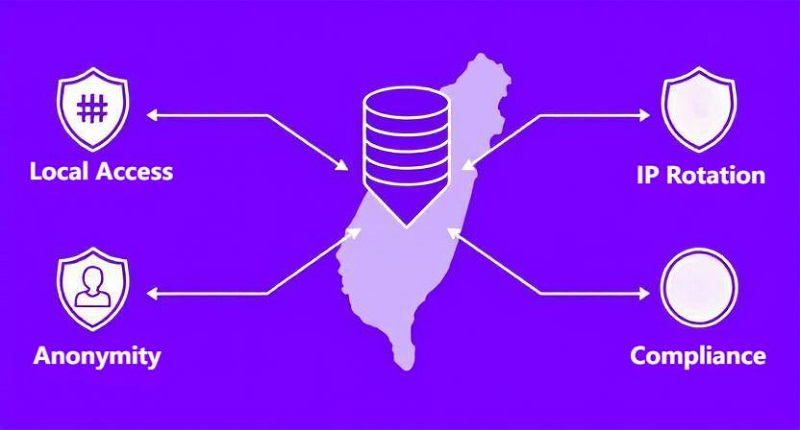
Proxies, particularly residential ones, resolve these challenges by offering:
● Anonymity: Proxies mask the advertiser’s IP, preventing detection by Google’s anti-bot systems or ad fraudsters.
● Local IP Access: Taiwanese IPs ensure ads are viewed as local users see them, providing accurate placement and compliance data.
● IP Rotation: Rotating IPs after a set number of requests or time intervals (e.g., every 5 requests or 60 seconds) minimizes CAPTCHA triggers and bans, enabling scalable verification.
● Fraud Detection: By simulating real-user environments, proxies help identify fraudulent activities like fake clicks or misplacements.
● Compliance Assurance: Proxies allow advertisers to verify ads from a Taiwanese perspective, ensuring alignment with local regulations.
Technical Implementation with Proxies
For developers and data analysts, proxies can be integrated into ad verification workflows using tools like Python and OkeyProxy’s residential proxies. Here’s a simplified example:
import requests
from bs4 import BeautifulSoup
# OkeyProxy configuration for Taiwanese IP
proxy = {
"http": "http://username:[email protected]:port",
"https": "http://username:[email protected]:port"
}
# Request to verify Google Ads
url = "https://www.google.com/search?q=taiwan+insurance"
response = requests.get(url, proxies=proxy, timeout=10)
# Parse ad data
soup = BeautifulSoup(response.text, 'html.parser')
ads = soup.find_all('div', class_='ad-class') # Adjust class based on Google’s structure
for ad in ads:
title = ad.find('h3').text
link = ad.find('a')['href']
print(f"Ad Title: {title}, Link: {link}")
This script uses OkeyProxy to access Google Ads with a Taiwanese IP, parse ad data, and verify placements. IP rotation and CAPTCHA mitigation can be configured via OkeyProxy’s dashboard to enhance reliability.
Why Choose OkeyProxy?
OkeyProxy offers over 150 million residential IPs, including a robust pool of Taiwanese IPs, ensuring high-speed, secure, and anonymous ad verification. Its intuitive dashboard simplifies IP rotation, authentication, and analytics, making it ideal for businesses and developers.
Start your free trial or explore plans at OkeyProxy.
FAQs
Why do I keep getting CAPTCHAs during ad verification?
Repetitive requests from a single IP trigger Google’s anti-bot systems. OkeyProxy’s IP rotation and residential proxies mimic real users, reducing CAPTCHA occurrences.
How do I integrate proxies with my existing tools?
Configure your scraping tool (e.g., Python’s requests or Selenium) with OkeyProxy’s proxy settings. The dashboard provides easy setup instructions and API support.
What if my proxy connection fails?
Check authentication credentials and ensure the correct proxy endpoint (e.g., tw-residential.okeyproxy.com) or reach out to OkeyProxy’s customer service.
Can proxies verify ads on platforms other than Google?
Yes, OkeyProxy supports ad verification across multiple platforms, including social media, using Taiwanese IPs to ensure accurate regional insights.
How do I scale verification without getting blocked?
Use OkeyProxy’s rotating IPs and set request limits (e.g., 5–10 per minute per IP). The dashboard’s analytics help monitor and optimize performance.
Conclusion
Ad verification in Taiwan requires proxies to overcome geographic restrictions, anti-bot measures, regulatory hurdles, and fraud risks. By providing Taiwanese IPs, anonymity, and scalability, proxies ensure accurate and compliant ad placements.
OkeyProxy’s reliable residential proxies empower advertisers to verify Google Ads effectively, optimizing campaigns for Taiwan’s dynamic market.
Enhance your ad verification strategy today!
