


















What Are Shared Proxies? A Comprehensive Guide for Beginners
In the rapidly evolving digital landscape of 2026, data has become the most valuable currency. Whether you are a small business owner tracking competitor prices or a researcher gathering public information, the tools you use to access the web determine your efficiency.
One of the most common yet misunderstood tools in this space is the shared proxy. This guide will explore everything from the basic definition to advanced selection strategies, helping you decide if this is the right solution for your project.
What Are Shared Proxies?
At its core, what are shared proxies? A shared proxy is an intermediary server that allows multiple users to browse the internet using the same IP address simultaneously. It acts as a cost-effective shield, masking your personal IP address by routing your traffic through a central server.
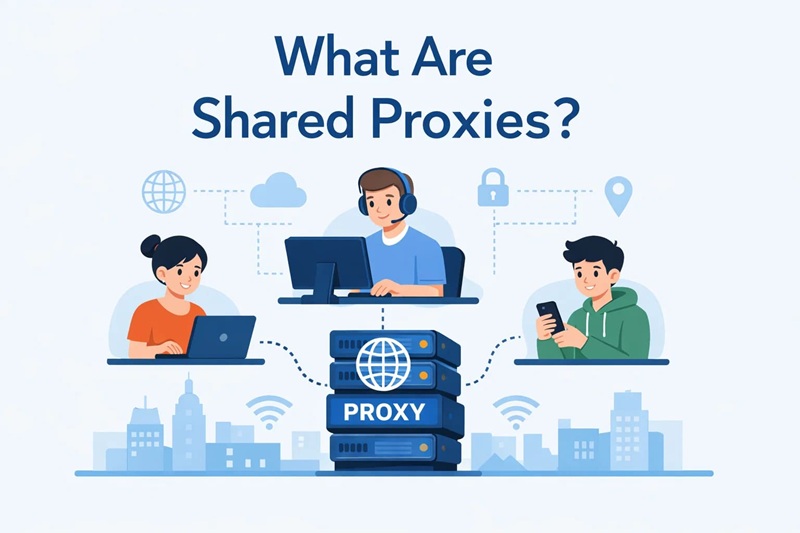
When people discuss what are shared proxies, they are typically referring to Datacenter Proxies. These are IP addresses owned by cloud hosting companies and data centers rather than residential Internet Service Providers (ISPs).
Because these IPs are shared among a pool of users, the cost of maintenance is split, making them significantly more affordable than dedicated alternatives. While they offer a high degree of utility for high-volume, low-risk tasks like web scraping, they generally provide lower stability because the actions of one user can affect the reputation of the IP for everyone else.
Understanding the definition is only the first step; to use them effectively, we must look at the mechanics under the hood.
How Do Shared Proxies Work?
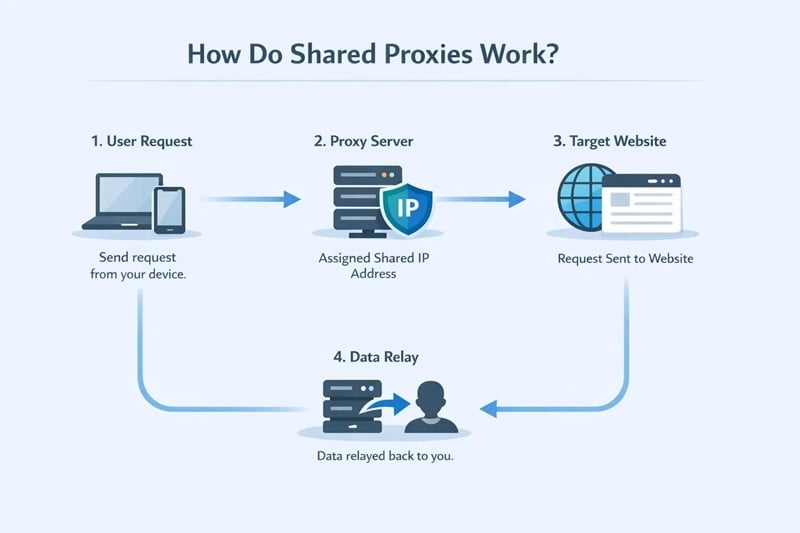
The technical process of a shared proxy is straightforward but efficient. When you send a request to a website, it doesn't go directly to the target server. Instead, it travels to the proxy server first.
The Request Routing Process
- User Request: You send a data request from your device.
- Proxy Server: The request hits the shared proxy server, which strips away your original IP and replaces it with the shared IP.
- Target Website: The website sees the request coming from the proxy server and sends the data back to that IP.
- Relay: The proxy server identifies which user sent the original request and relays the data back to you.
A helpful way to visualize this is through a "carpooling" analogy. If a private proxy is like a personal limousine where you have the entire vehicle to yourself, a shared proxy is like a city bus. You share the space and the cost with other passengers, all traveling toward a similar destination. You arrive at the same place, but the journey is much cheaper because the expenses are shared.
Now that we understand the "how," let's examine why so many businesses prioritize these tools in their tech stack.
Key Benefits: Why Choose Shared Proxies?
The popularity of shared proxies isn't accidental; they offer specific advantages that dedicated IPs cannot match, particularly regarding budget and scale.
- Cost-Effectiveness: This is undoubtedly the biggest selling point. Shared proxies are incredibly budget-friendly, allowing startups and independent developers to access massive IP pools without the enterprise-level price tag.
- Anonymity in Numbers: There is a unique "obfuscation effect" with shared IPs. Because the traffic of hundreds of users is mixed together, it becomes significantly harder for a website to track the specific behavior of a single user. Your digital footprint is effectively buried under a mountain of other data.
- Accessibility and Ease of Use: Most shared proxy services are designed for rapid deployment. They are easy to acquire and usually require minimal configuration, making them perfect for those who need to scale a project quickly.
While the benefits are clear, utilizing shared resources always comes with a set of trade-offs that every user must consider.
The Trade-offs: Risks and Limitations
The very "sharing" that makes these proxies cheap also introduces certain technical hurdles.
- The "Bad Neighbor" Effect: This is the most significant risk. If another user sharing your IP address violates a website's Terms of Service or performs aggressive botting, the website may block that IP. Consequently, you are blocked as well, even if your own behavior was perfectly compliant.
- Speed and Performance: Since multiple users are drawing from the same bandwidth, you may experience latency or slower download speeds during peak usage times.
- Lower Success Rates on High-Security Sites: Major platforms like Amazon, Google, or Craigslist have sophisticated filters. They often assign a lower "trust score" to Datacenter IPs. If the shared IP has been used heavily on these sites before, your request might be met with a CAPTCHA or a soft block.
To decide if these limitations are deal-breakers, it helps to see how shared proxies stack up directly against their private counterparts.
Shared vs. Private (Dedicated) Proxies: A Comparison
Before choosing a plan, you must understand the distinction between shared and private (dedicated) proxies. A Private Proxy is reserved for one user only, offering total control and maximum speed, but at a premium price.
| Feature | Shared Proxies | Dedicated (Private) Proxies |
|---|---|---|
| Cost | Extremely Low (Budget-friendly) | High (Premium pricing) |
| Speed | Variable (Depends on other users) | High (Exclusive bandwidth) |
| Security | Risk of "Bad Neighbor" effect | High (Total control) |
| Success Rate | Moderate | Very High |
| Best For | High-volume, low-risk tasks | Account management, SEO |
Despite the performance gap, shared proxies remain the champion for specific, high-volume tasks where cost-per-IP is the primary metric.
Best Use Cases for Shared Proxies
Shared proxies are not a universal solution, but they excel in environments where security requirements are moderate and the volume of requests is high.
- General Web Scraping: If you are crawling public directories or websites with basic security, shared proxies provide the best ROI.
- Market Research: Use them to monitor competitor pricing and product listings across different regions without revealing your corporate IP.
- SEO Monitoring: They are excellent for checking keyword rankings and performing SERP analysis across various locations.
- Casual Browsing: For individuals looking for basic anonymity and the ability to view geo-restricted content without needing high-stakes security.
To achieve success in these areas, however, the quality of the provider you choose is the most critical factor.
How to Choose a Quality Shared Proxy Provider
Not all shared proxies are created equal. When evaluating a provider in 2026, look for these three pillars of quality:
- Pool Size: A provider with millions of IPs is always better. A larger pool means that even if a few IPs are flagged, there are plenty of fresh ones to take their place.
- Reputation Management: Premium providers actively monitor their IP health and "cool down" or rotate out IPs that have been blacklisted by major sites.
- Protocol Support: Ensure the provider supports HTTP/HTTPS for web traffic and SOCKS5 for more complex, high-speed data transfers.
For those seeking a balance of performance and value, OkeyProxy stands out as a top-tier option. They offer high-performance shared datacenter proxies as well as a massive pool of over 150 million residential proxies. Whether you need high-speed datacenter IPs for scraping or high-trust residential IPs for account management, OkeyProxy provides a flexible range of packages to fit your needs. With OkeyProxy, you're guaranteed a seamless experience backed by a reputable network.

Best Practices for Using Shared Proxies
To maximize your success rate with shared IPs, follow these professional tips:
- Implement Rotation: Don't rely on a single shared IP for too long. Use a rotation script to switch IPs every few minutes to avoid triggering rate limits.
- Control Your Frequency: Even if the IP is shared, avoid sending thousands of requests per second. Use "sleep" timers in your code to mimic human behavior.
- Use Proper Headers: Always send a legitimate "User-Agent" string with your requests to make the traffic look like it's coming from a standard browser.
Following these practices ensures that you get the most out of your investment while minimizing the risks associated with shared resources.
Conclusion
Understanding what are shared proxies is essential for any modern digital operation. They offer a unique combination of affordability and anonymity that makes them indispensable for large-scale data collection and market research. While they do come with risks like the "bad neighbor" effect, these can be mitigated by choosing a high-quality provider and following industry best practices.
In the end, the best proxy is the one that matches your project's specific needs. If you need a cost-effective way to scale your online presence, shared proxies are an excellent place to start.
Frequently Asked Questions
Q: Are shared proxies safe?
A: Yes, they are safe for general browsing and data collection. However, you should avoid using them for sensitive tasks like online banking or accessing private personal accounts, as you are sharing the server environment with others.
Q: Why is my shared proxy speed slowing down?
A: This usually happens during peak hours when many users are connected to the same server. If performance is a recurring issue, you might consider upgrading to a dedicated or residential plan.
Q: Are dedicated proxies safer than shared proxies?
A: Technically, yes. Because you are the only user, there is zero risk of someone else's activity causing the IP to be banned, providing a much more stable and "private" experience.
Q: What is the difference between shared proxies and free proxies?
A: Shared proxies are paid services provided by companies that maintain the servers and monitor IP health. Free proxies are often unmonitored, extremely slow, and can even be malicious traps designed to steal user data. Always choose a reputable paid provider like OkeyProxy over a free one.
