

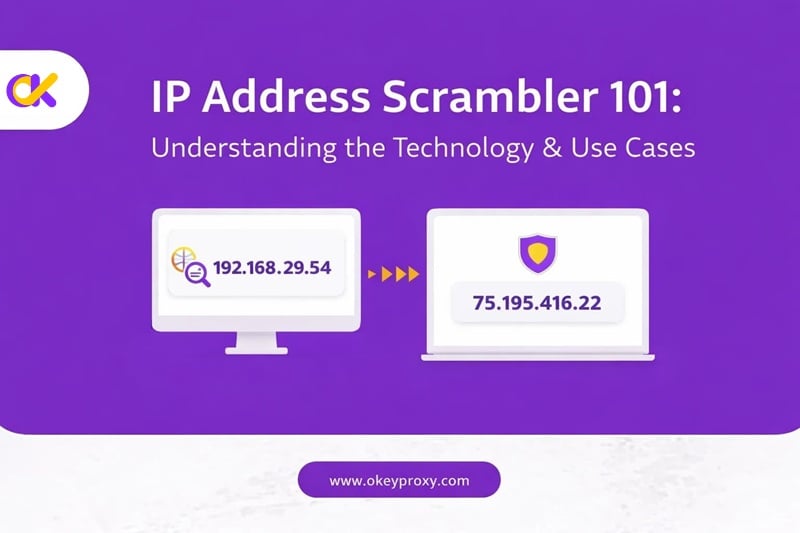
Every click you make is tied to your IP address—your digital license plate. In 2026, the IP address scrambler has become an essential tool for protecting this data. By using legitimate technologies like rotating proxies and VPNs, users can securely mask their online identity. This guide covers how these tools function, their importance in the business world, and the best practices for legal and ethical use.
What Is an IP Address Scrambler and How Does It Work?
An IP address scrambler is not a single “magic” button, but rather a system (often powered by residential proxies or VPN networks) that changes your public IP address at specific intervals or with every new request. These tools do not physically alter the IP address assigned to you by your Internet Service Provider (ISP); instead, they route your traffic through a secondary server that acts as a mask.
The “Middleman” Concept
Think of the scrambler as a secure relay. When you send a request to a website:
- Your data goes to the scrambler server first.
- The server strIPs away your original IP address.
- The server assigns a new IP from its pool (the “scrambled” address).
- The request reaches the destination website, which only sees the new IP.
Static Scrambling vs. Dynamic Scrambling
Understanding the difference between these two is vital for choosing the right tool:
- Static Scrambling: You are assigned a new IP address that remains the same for the duration of your session (often called a “sticky session”). This is ideal for logging into accounts where a changing IP might trigger a security alert.
- Dynamic Scrambling (IP Rotation): This is the “true” scrambler experience. Your IP address changes automatically—either every few minutes or with every single request you make. This makes it nearly impossible for websites to track your cumulative activity.
The Role of Encryption
Many modern IP address scrambler solutions, particularly VPNs and SOCKS5 proxies, also include a layer of encryption. This ensures that even if someone were to intercept your data between your device and the relay server, they wouldn’t be able to read the contents.
Common Types of IP Address Scrambling Tools
To effectively use an IP address scrambler, you must understand the different tools available. Each has a specific strength depending on your goals.
🔄 Rotating Proxies (Best for Automation & Web Scraping)
Rotating proxies are the elite version of an IP address scrambler. They automatically switch your IP address from a massive pool of addresses. Because they can provide a new IP for every single connection, they are the preferred choice for developers and data scientists who need to gather information without being blocked.
🛡️ VPNs (Best for General Privacy)
A Virtual Private Network is the most user-friendly scrambler. It replaces your IP with one from a data center server and encrypts your entire internet connection. It is perfect for everyday use, such as protecting your data on public Wi-Fi or hiding your browsing history from your ISP.
🧅 The Tor Browser
Tor (The Onion Router) routes your traffic through at least three different nodes (servers) across the globe. By the time your request reaches the internet, it has been “scrambled” three times. While it offers high anonymity, it is significantly slower than proxies or VPNs.
📱 Mobile Data & Airplane Mode
A “manual” version of scrambling involves using a smartphone. When you toggle Airplane Mode on and off, your mobile carrier often assigns you a new IP address from their pool. This is a quick, localized way to get a fresh digital identity.
Comparison Table: Which Scrambler is Right for You?
| Tool Type | Scrambling Method | Primary Benefit | Best Use Case |
|---|---|---|---|
| Rotating Proxies | Automatic (per request/time) | High trust & Scalability | Web scraping, SEO, Multi-accounting |
| VPN | Single Server Switch | Full encryption | Personal privacy, Public Wi-Fi security |
| Tor Browser | TrIPle-node routing | Maximum anonymity | Journalism, Whistleblowing |
| Mobile Data | Manual Reset | Ease of use | Quick local IP change |
Legitimate and Ethical Application Cases
There is a common misconception that an IP address scrambler is only for those with something to hide. In reality, these tools are the backbone of modern business intelligence and cybersecurity.
🛡️ Enhancing Personal Security
In 2026, cyberattacks like DDoS (Distributed Denial of Service) are common. By using an IP address scrambler, you hide your home network’s “front door,” making it much harder for malicious actors to target your specific connection.
📊 Market Research & Price Intelligence
E-commerce platforms often use “dynamic pricing,” showing different prices to users based on their location or browsing history. Businesses use an IP address scrambler to view fair, unbiased market data across different regions, ensuring they stay competitive.
🔍 SEO & Ad Verification
Marketing agencies use scramblers to verify that their advertisements are appearing correctly in different cities or countries. Without a localized IP, they might see a “global” version of a site rather than the specific local version their clients are paying for.
🧪 Software & Localization Testing
Developers use an IP address scrambler to test how their apps perform in different environments. A central testing team in Singapore can use residential IPs to simulate users in London, Tokyo, and New York, ensuring the software works perfectly for everyone.
Why Businesses Prefer a “Residential IP Address Scrambler”
When it comes to professional use, not all scrambled IPs are equal. Most websites can easily detect “Datacenter IPs” (those belonging to servers). This is why the “Residential” option is the gold standard.
Residential IPs belong to real internet service providers (like Comcast, AT&T, or BT). When you use an IP address scrambler backed by residential IPs, you appear as a genuine home user. This drastically reduces the chances of encountering CAPTCHAs or being flagged as a bot.
Editor’s Choice: With a massive pool of over 150 million real residential IPs, OkeyProxy allows users to “scramble” their identity with incredible precision. Whether you need to rotate IPs every minute or maintain a stable connection in a specific city, OkeyProxy provides the infrastructure to handle thousands of requests simultaneously without hitting rate limits.
Staying Legal: The Compliance Checklist
Using an IP address scrambler is a legal right in most jurisdictions—it is a tool for privacy. However, how you use it matters. To ensure you stay on the right side of the law and ethics, follow this checklist:
- ✅ Respect Terms of Service (TOS): While changing your IP is legal, using it to scrape a website that explicitly forbids it in their TOS can result in a permanent ban of your account.
- ✅ Avoid Illegal Content: An IP address scrambler provides privacy, not immunity. It should never be used to access illegal material or conduct malicious activities.
- ✅ Data Protection (GDPR/CCPA): If you are a business using proxies to collect data, ensure you are doing so in compliance with data privacy laws. Scramblers help anonymize the data you collect, which is often a key requirement of the GDPR.
- ✅ Use Reputable Providers: Avoid “free” scramblers. They often log your data and sell it to third parties, defeating the entire purpose of privacy.
FAQ: Common Questions About IP Address Scrambling
Is it illegal to change my IP address?
No. Changing your IP address is a standard privacy measure used by millions of people and businesses worldwide to protect their data and test their systems.
Can a website detect if I am using an IP address scrambler?
If you use a low-quality, free VPN or a datacenter proxy, yes—many websites can detect it. However, high-quality residential proxies (like those from OkeyProxy) are virtually indistinguishable from regular household connections.
Does an IP scrambler slow down my internet?
It can. Because your traffic is taking a “detour” through another server, you may notice a slight increase in latency. However, high-end providers in 2026 offer optimized speeds that make the delay unnoticeable for most tasks.
Conclusion: Taking Control of Your Digital Footprint 🌐
In a world where almost every move online is tracked, an IP address scrambler is no longer just a tool for tech experts—it’s your personal shield for the digital age. It’s about giving you the power to protect your private info and helping businesses grow by accessing global data without borders.
Whether you’re shielding your home Wi-Fi from hackers, checking if your ads look right in another country, or just want to browse the web without being followed, an IP address scrambler is your best ally. By choosing a trusted provider like OkeyProxy and using the tech responsibly, you’re not just changing an IP—you’re ensuring a safer, more open internet for yourself and your business.