

In 2026, the excitement of a major concert announcement or a championship sports game is almost immediately followed by a wave of digital anxiety. For millions of fans, the experience is the same: you log on at the exact second tickets go on sale, wait in a virtual queue of 50,000 people, only to see the dreaded “Sold Out” message appear within seconds. This frustration isn’t just due to high demand; it is the result of a highly sophisticated, high-speed digital battlefield where every millisecond and every unique identity counts.
To navigate this competitive landscape, professional resellers and savvy “super-fans” have turned to a specialized tool: チケットプロキシ. These digital intermediaries allow users to bypass the strict limitations and security hurdles set by major ticketing platforms. By understanding how ticketing proxies work, you can shift the odds back in your favor, transforming the ticket-buying process from a game of luck into a strategic operation. In this guide, we will explore everything you need to know about mastering the queue with the right proxy strategy.
What Exactly Are Ticket Proxies?
Before diving into the technical strategies, we must first define what we are working with. Simply put, チケットプロキシ are specialized IP addresses designed to act as a mask for your real internet identity. When you connect to a site like Ticketmaster, AXS, or Eventbrite, the platform logs your IP address to ensure you aren’t a bot and that you aren’t trying to buy more than your fair share of tickets. A ticket proxy replaces your IP with one from a massive pool of addresses, making it appear as though you are a completely different person accessing the site from a different location.
The core function of these ticketing proxies is to bypass the “one-per-household” or “one-per-account” limits that define modern ticket sales. If you attempt to open multiple browser tabs to increase your chances, the ticketing site will recognize your single IP address and likely block your entire session. However, by using a unique proxy for each tab or account, you can effectively be in ten different places at once without triggering any red flags. Furthermore, ticket proxies are essential for bypassing geographic restrictions. For example, if you are located in New York but want to buy tickets for an exclusive London concert that is only available to local IP addresses, a UK-based proxy allows you to appear as a local resident, saving you from international taxes and restricted access.
While a standard proxy might just hide your location, a true ticketing proxy is optimized for speed and high-trust signatures. These servers are built to handle the intense traffic spikes that occur during “drops,” ensuring that your connection remains stable even when millions of other users are slamming the server at the same time.
The Main Types of Ticketing Proxies
Choosing the right tool for the job is essential, as not all チケットプロキシ are created equal. The “type” of proxy you choose will determine your success rate, your speed, and your budget. Understanding the differences between residential, mobile, ISP, and datacenter options is the first step toward building a successful ticketing strategy.
レジデンシャル・プロキシ: These are the gold standard for ticketing. A residential proxy uses an IP address assigned to a real home by an Internet Service Provider (ISP). Because these addresses belong to actual households, ticketing platforms trust them implicitly. They are much harder to detect and block because they look exactly like a regular fan sitting in their living room.
モバイルプロキシ: These proxies route your traffic through 3G, 4G, or 5G mobile networks. They offer the highest level of anonymity because thousands of real people often share the same mobile IP range. Ticketing sites are very hesitant to block these IPs because doing so would result in blocking thousands of legitimate mobile users. However, they are typically the most expensive option.
ISP Proxies (Static Residential): These are a “hybrid” solution. They are hosted in data centers for incredible speed but are registered under residential ISP names. This gives you the reliability and speed of a professional server with the “trust score” of a home connection—making them a secret weapon for professional resellers.
データセンター・プロキシ: These are the fastest and most affordable options, but they are also the most vulnerable. Because they originate from cloud servers rather than home or mobile networks, sophisticated platforms like Ticketmaster can easily identify them as “non-human” and block them instantly. They are rarely recommended for high-demand ticket drops in 2026.
Comparison: Which Proxy Type Should You Use?
| プロキシ・タイプ | スピード | 信頼レベル | Best For… |
|---|---|---|---|
| レジデンシャル | 中程度 | 高い | Bypassing “Bot” detection on major sites. |
| モバイル | 中程度 | Highest | High-risk drops with extreme security. |
| ISP (Static) | Fastest | 高い | Long sessions and fast checkout. |
| データセンター | 非常に速い | 低い | Basic scraping or low-security events. |
How Ticket Proxies Work Behind the Scenes
To use ticketing proxies effectively, it helps to understand the mechanics of the “virtual line.” When you join a queue, the ticketing server evaluates your connection based on several factors: your IP reputation, your geographic location, and your behavioral patterns. A high-quality proxy service manipulates these factors to ensure you stay in the line and complete your purchase without interruption.
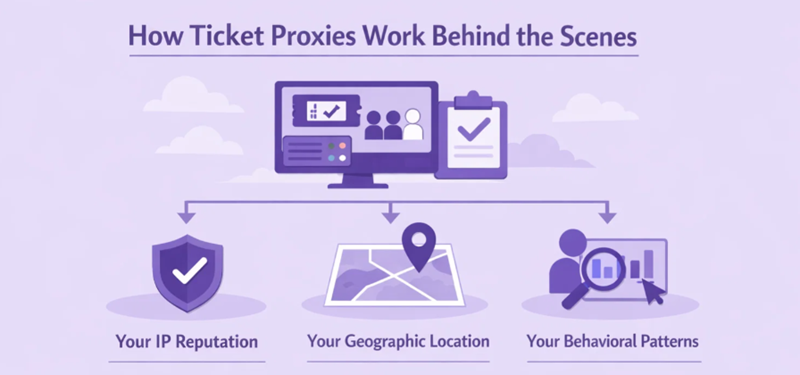
One of the most critical features is IPローテーション. Instead of using a single IP for the entire time you are on the site, a rotating proxy can switch your identity at set intervals or with every new request. This “identity switching” prevents the ticketing platform from seeing a single user making too many requests in a short period, which is the number one sign of a bot. By rotating through different チケットプロキシ, you appear as a diverse group of individual fans rather than a single automated script.
Another major factor is Geographic Advantage. In the world of ticketing, “latency” (the time it takes for your data to travel to the server and back) is your biggest enemy. If a ticketing server is located in Virginia, and you are trying to buy tickets from California, you are at a disadvantage. By using a proxy server located physically close to the ticketing data center, you can shave milliseconds off your response time. In a queue where 50,000 people are fighting for 5,000 seats, those milliseconds are the difference between the front row and a “Sold Out” screen. Furthermore, these proxies are designed to exhibit “Human-like” characteristics, such as consistent header information and realistic connection speeds, allowing them to dodge even the most advanced anti-scraping tools.
Why Regular Proxies Simply Won’t Cut It
Many beginners make the mistake of trying to use a standard VPN or a cheap datacenter proxy they found online. In 2026, this is almost a guaranteed way to get banned. Major ticketing platforms have invested millions into “Bot Mitigation” technology that can identify “low-trust” IPs in a heartbeat. This leads to the “Datacenter Trap,” where your IP is blacklisted before you even enter the queue.
The reason ticketing proxies succeed where others fail is the 信頼スコア. Websites use databases to see who owns an IP address. If the owner is a known cloud provider like Amazon Web Services or DigitalOcean, the site assumes you are a bot. If the owner is a residential ISP like Comcast or AT&T, the site assumes you are a real person. Ticket proxies specifically utilize these high-trust residential and ISP ranges to remain invisible. While a regular proxy might hide your location, only a dedicated ticketing proxy provides the “credentials” needed to pass through a high-security digital checkpoint.
Who Really Needs Ticket Proxies?
While the term “proxy” might sound like something only a programmer would use, the user base for チケットプロキシ is quite broad. Generally, anyone who cannot afford to lose out on a specific event can benefit from this technology.
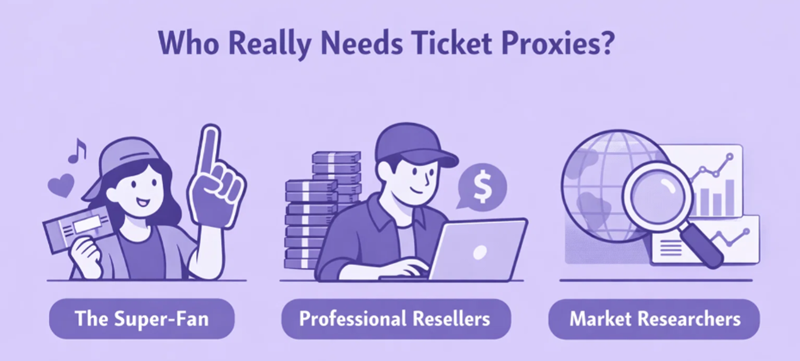
- The Super-Fan: Individual fans who want to ensure they get tickets for their favorite artist’s tour without paying 5x the price on a secondary market. Using a few ticketing proxies gives them multiple “entries” into the queue.
- Professional Resellers: Individuals or small businesses that manage dozens of accounts to secure large blocks of tickets. For them, proxies are a non-negotiable business expense to prevent “shadow-banning” and account closures.
- Market Researchers: Companies that need to track ticket availability and pricing trends across different global regions in real-time. Without チケットプロキシ, they would be blocked for making too many requests to the site’s database.
Top 5 Ticket Proxy Providers in 2026
The market is flooded with providers, but only a few have the infrastructure required to handle the world’s biggest ticket drops. Here is a breakdown of the top players in the industry today:
- Bright Data: Known for having one of the largest IP pools in the world (over 150 million IPs). It is a powerhouse for professional resellers who need massive scale and high-quality residential data.
- IPRoyal: A great choice for those who need a mix of residential and ISP proxies. They offer specialized “Sneaker and Ticket” pools that are optimized for high-speed retail environments.
- NodeMaven: This provider is highly regarded for its “clean” IP pools. Their mobile proxies are particularly effective for bypassing the toughest security on sites like Ticketmaster and AXS.
- OkeyProxy: オッケープロキシー has established itself as a top HTTP & SOCKS5 proxy provider その あらゆる代理ニーズに対応. With a massive pool of 150M+ residential IPs and incredibly low latency, it is the go-to for both individual fans and small resellers.
- SimplyNode: A specialized provider that focuses on residential proxies for high-demand events. They are known for a simple interface and reliable connections during major tour announcements.
Don’t Let the “Sold Out” Screen Win!
Whether you are a fan trying to secure a single seat or a pro managing a resale business, you need a provider that combines speed with trust. オッケープロキシー offers the high-performance residential and ISP proxies you need to jump the queue.
👉 Start Your Success Story with OkeyProxy Now!
Choosing Your Provider: What to Look For
When you are selecting a provider for ticketing proxies, don’t just look at the price. A cheap proxy that fails during the checkout process is a waste of money. Instead, focus on Speed and Latency. As mentioned, a 100ms delay can ruin your chances. You need a provider that offers servers in the same regions as the ticketing platforms.
Secondly, consider the IPプールサイズ. You want a provider with millions of addresses. If a provider has a small pool, there is a high chance the IP you get has already been “burnt” or flagged by the ticketing site by another user. Finally, ensure they have Specific Geographic Coverage. If you are buying tickets in the US, you need a proxy in the US. A global provider with city-level targeting is essential for international event access.
Strategies for a Successful Purchase
Having チケットプロキシ is only half the battle; you also need a winning strategy. Professional buyers often use Anti-detect Browsers (like アドパワー または Mulogin) alongside their proxies. This allows them to create multiple, completely unique browser profiles that do not share cookies or “browser fingerprints.” By assigning one ticketing proxy to each profile, you create a perfect digital disguise that is nearly impossible for security filters to catch.
Additionally, always warm up your accounts. Log into the ticketing site a few minutes early through your proxy to establish a “session.” However, do not refresh too aggressively, as this can still trigger rate-limiters. The goal is to act like a fast, but human, user.
Ethics, Compliance, and the Law
It is important to address the legal landscape of using ticketing proxies. In many jurisdictions, using a proxy for privacy or to access different regions is perfectly legal. However, the Better Online Ticket Sales Act (BOTS Act) of 2016 in the United States and similar regulations in other countries prohibit the use of “automated software” (bots) to circumvent security measures to purchase tickets in bulk.
一方 チケットプロキシ themselves are tools for privacy and identity management, you should always review the Terms of Service of the ticketing platform. Violating these terms—even if not illegal—can lead to your tickets being canceled or your account being permanently banned. Always strive to use this technology to ensure fair access and security rather than to manipulate the market unfairly.
結論
The world of online ticketing in 2026 is a fast-paced, high-stakes environment where traditional browsing methods are often not enough. Ticket proxies have become an essential component of the digital toolkit for anyone looking to navigate this space successfully. By providing the anonymity, speed, and geographic flexibility needed to bypass modern security filters, ticketing proxies empower you to take control of your experience.