
Whether you are trying to bypass regional content blocks, manage multiple social media accounts, or scrape data without getting your IP banned, the right proxy setup is your foundation. Among the various protocols available, SOCKS5 stands out as the most versatile and reliable choice for modern internet users. However, even the best proxy is useless if you don’t know how to set it up correctly. In this comprehensive guide, we will walk you through everything you need to know about SOCKS5 configuration, from basic parameters to step-by-step instructions for every major operating system and device.
SOCKS5 Proxy 101: Understanding the Protocol
A Proxy SOCKS5 is a “Socket Secure” internet protocol that routes your network packets through a proxy server. Unlike standard HTTP proxies that only handle web traffic, SOCKS5 operates at Layer 5 of the OSI model, meaning it can handle any type of traffic — including HTTP, HTTPS, FTP, and even UDP (essential for gaming and streaming).
SOCKS5 vs. Older SOCKS Versions
If you have spent any time in the proxy world, you have likely seen “SOCKS4” mentioned alongside SOCKS5. While SOCKS4 was a solid foundation, SOCKS5 is a significant upgrade. The primary differences are that SOCKS5 supports Tráfico UDP and provides advanced authentication methods, ensuring that only authorized users can access the proxy server. For a deeper dive into these technical differences, you can read our detailed comparison on SOCKS4 vs. SOCKS5.
SOCKS5 vs. HTTP vs. VPN: Which Should You Use?
Choosing the right tool depends on your specific needs for speed, security, and traffic type. Below is a breakdown of how SOCKS5 stacks up against common alternatives:
| Característica | Proxy SOCKS5 | Proxy HTTP | VPN |
|---|---|---|---|
| Traffic Type | Any (TCP/UDP) | Web (HTTP/HTTPS) | System-wide (All) |
| Cifrado | No (Lighter & Faster) | No | Yes (End-to-End) |
| Velocidad | Fast (Low Overhead) | Rápido | Slowest (Due to Encryption) |
| El mejor caso de uso | Gaming, Scraping, P2P | Basic Web Browsing | Public Wi-Fi Security |
Basic Parameters for SOCKS5 Configuration
Before you start clicking through your settings, ensure you have the following four pieces of information from your provider:
- Dirección del servidor: This is either an IP address (e.g., 192.168.1.1) or a hostname (e.g., proxy.example.com).
- Número de puerto: For SOCKS5, the most common port is 1080, but your provider may assign a custom port.
- Username: Required if the proxy uses username/password authentication.
- Password: Required alongside the username.
Once you have these details ready, we can move on to the actual setup process on your specific device.
Step-by-Step: Manual SOCKS5 Configuration on Every Device
To begin using a SOCKS5 proxy, you first need to acquire high-quality IPs from a trusted provider. Free proxies are notoriously unstable and unsafe; for professional tasks, consider a provider like OkeyProxy, which offers a wide range of residencial, ISP, and proxies de centros de datos optimized for SOCKS5. After purchasing a subscription, your dashboard will generate the server details mentioned above.
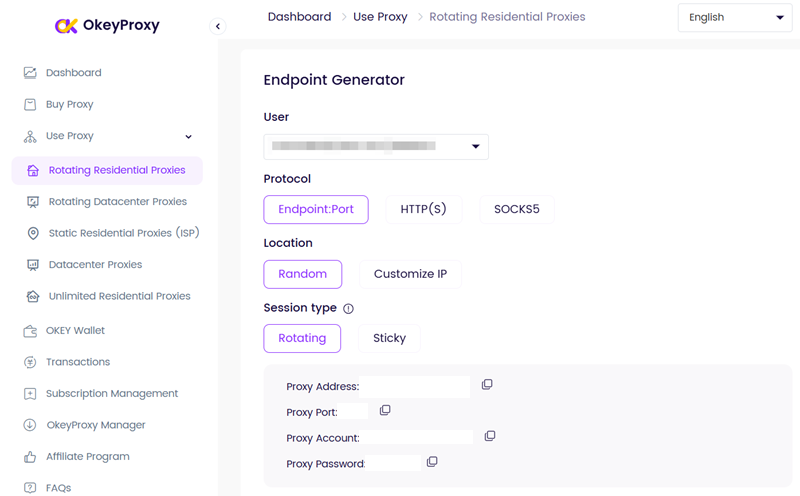
With your credentials in hand, follow the steps below for your operating system or device.
1. SOCKS5 Configuration for Windows 11/10
Method A: Via Windows Settings (Basic / HTTP-compatible traffic only)
- Pulse Gana + I to open Ajustes.
- Vaya a Redes e Internet → Proxy.
- En Configuración manual del proxypulse Editar.
- Toggle Utilizar un servidor proxy a En.
- Enter your proxy’s Dirección IP y Puerto (e.g., 1080) in the respective fields.
- Optionally, add addresses to the “Don’t use the proxy server for these addresses” field to exclude local/intranet traffic.
- Haga clic en Guardar.
- Open your browser and visit whatismyip.com to verify that your IP has changed.
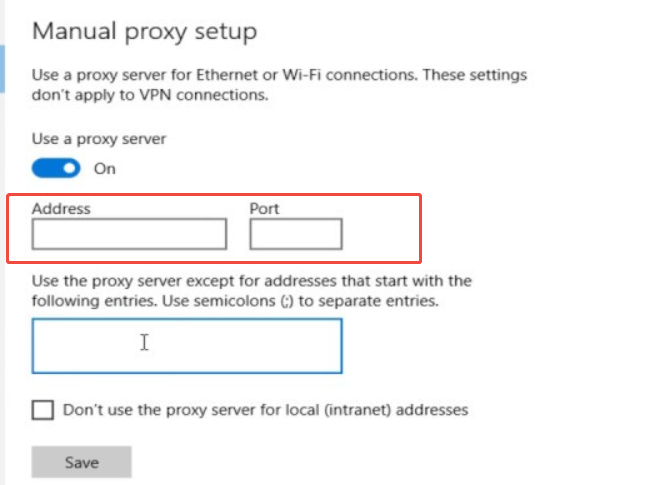
Limitation: This method uses the legacy WinINet stack, which only supports SOCKS4, not full SOCKS5. It will not handle UDP traffic or username/password authentication correctly for all applications.
Method B: Via Proxifier (Full SOCKS5 System-Wide — Recommended)
- Download and install Proxifier del sitio web oficial.
- Open Proxifier and go to Profile → Servidores proxy.
- Haga clic en Add and enter your Server address y Puerto.
- Set the protocol to SOCKS Version 5.
- If your proxy requires authentication, check Autenticación and enter your Nombre de usuario y Contraseña.
- Haga clic en OK, then go to Profile → Proxification Rules to choose which applications route through the proxy.
- Haga clic en Consulte in the proxy server dialog to test the connection before saving.
Method C: Via Internet Options (Legacy — Supports SOCKS settings per type)
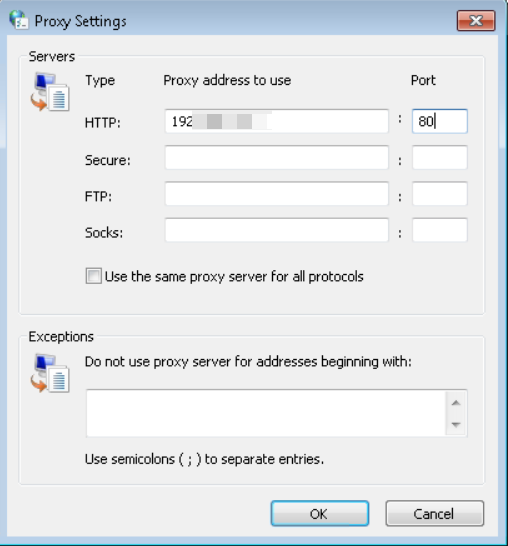
- Abrir Panel de control → Redes e Internet → Opciones de Internet.
- Ir a la Conexiones y haga clic en Configuración LAN.
- Consulte Utilice un servidor proxy para su LANy haga clic en Avanzado.
- Clear the HTTP, Secure, and FTP fields. In the Calcetines field, enter your proxy’s IP address and port.
- Haga clic en OK on all dialogs to save.
2. SOCKS5 Configuration for macOS (Sequoia / Sonoma)
- Haga clic en el botón Menú Apple (🍎) → Configuración del sistema.
- In the left sidebar, click Red.
- Select your active connection (e.g., Wi-Fi o Ethernet) and click Details… on the right.
- Haga clic en el botón Apoderados tab in the dialog that appears.
- In the protocol list on the left, find Proxy SOCKS and toggle its switch to En.
- En el Servidor field on the right, enter your proxy’s hostname or IP address.
- Introduzca el Puerto number (e.g., 1080) in the port field after the colon.
- If your proxy requires authentication, check “Proxy server requires password” and enter your Nombre de usuario y Contraseña.
- To exclude local network traffic, add addresses (e.g.,
*.local, 192.168.0.*) to the “Bypass proxy settings for these Hosts & Domains” field at the bottom. - Haga clic en OKy haga clic en Solicitar para guardar los ajustes.
- Open a browser and visit whatismyip.com to confirm the IP change.
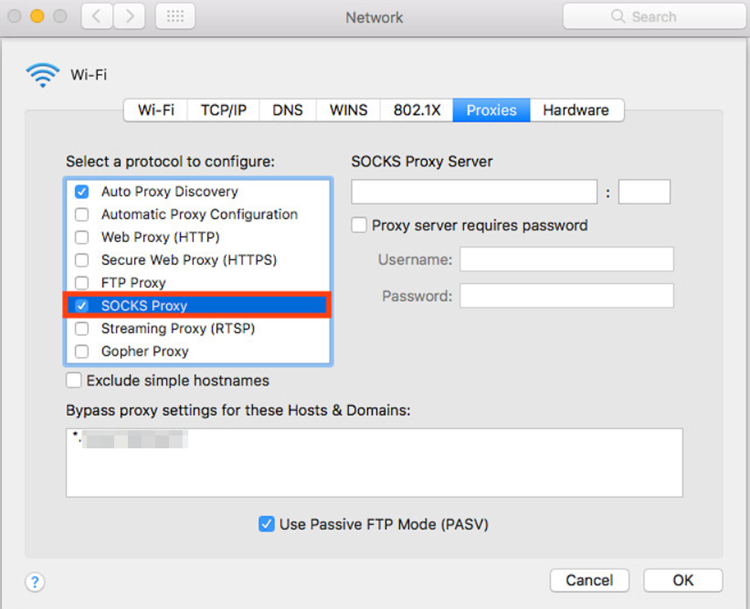
Note: Safari, Chrome, and Edge on macOS all inherit these system-level proxy settings automatically. Firefox uses its own proxy settings and must be configured separately (see the browser section below).
3. SOCKS5 Configuration for Linux
Method A: Via GNOME Desktop (GUI)
- Abrir Ajustes → Red.
- Click the gear icon next to your active network connection.
- Ir a la Proxy ficha.
- Set the method to Manual.
- Enter your SOCKS5 proxy address and port in the Socks Host field.
- Haga clic en Solicitar.
Method B: Via Environment Variables (Terminal — Per-session)
Add the following line to your ~/.bashrc o ~/.zshrc file for persistent configuration:
export ALL_PROXY="socks5://username:password@yourproxyip:port"export all_proxy="socks5://username:password@yourproxyip:port"
Then reload the file by running source ~/.bashrc. Note that this only affects applications that respect the ALL_PROXY environment variable.
Method C: Via ProxyChains (Force Any Application Through SOCKS5)
- Install ProxyChains:
sudo apt install proxychains4(Debian/Ubuntu) orsudo yum install proxychains(RHEL/CentOS). - Edit the configuration file:
sudo nano /etc/proxychains4.conf - At the bottom of the file, comment out any existing proxy lines and add:
socks5 yourproxyip port username password - Save the file and run any application through the proxy by prefixing it with
proxychains4:proxychains4 firefox
Method D: SSH Dynamic Tunneling (Create a Local SOCKS5 Proxy)
If you have SSH access to a remote server, you can create a local SOCKS5 proxy with a single command:
ssh -D 1080 -q -C -N [email protected]
This opens a local SOCKS5 proxy on 127.0.0.1:1080 that you can then configure in any application.
4. SOCKS5 Configuration for Browsers (Chrome, Edge, Firefox)
Firefox (Built-in Native SOCKS5 Support — All Platforms)
Firefox is unique in that it has its own network settings, independent of the operating system. This makes it the most straightforward browser for SOCKS5 configuration on any platform.
- Open Firefox and click the menu button (☰) → Ajustes.
- En el General tab, scroll to the very bottom to find Ajustes de red.
- Haga clic en Ajustes....
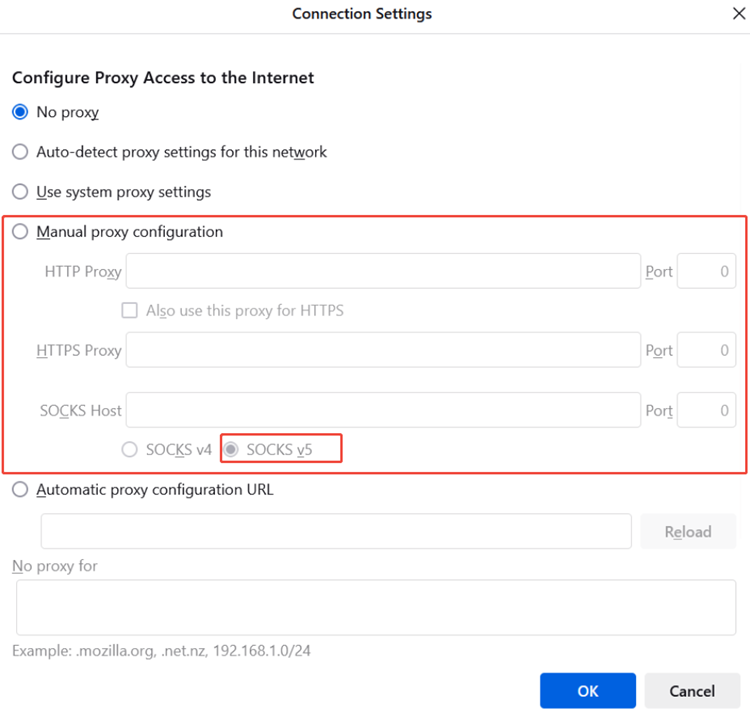
- Seleccione Configuración manual del proxy.
- Leave the Proxy HTTP y Proxy HTTPS fields empty.
- En el Anfitrión SOCKS field, enter your proxy’s IP address or hostname.
- Introduzca el Puerto number in the field to the right.
- Seleccione SOCKS v5 (not v4).
- Critically: Check the box for “Proxy DNS when using SOCKS v5” to prevent DNS leaks and ensure full anonymity.
- Haga clic en OK para ahorrar.
- If your proxy requires authentication, Firefox will automatically prompt you to enter your Nombre de usuario y Contraseña when you first load a website.
Google Chrome & Microsoft Edge (via ZeroOmega Extension)
Chrome and Edge do not have built-in per-browser SOCKS5 configuration — they rely on OS-level proxy settings by default. For browser-only SOCKS5 without affecting the entire system, use the ZeroOmega extension (the Manifest V3-compliant successor to the popular SwitchyOmega).
- Abra el Chrome Web Store (or Edge Add-ons store) and search for ZeroOmega.
- Haga clic en Add to Chrome (o Visite for Edge) to install it.
- After installation, click the ZeroOmega icon in the toolbar and select Opciones.
- In the left panel, click the “+” icon to create a new Proxy Profile.
- Name the profile (e.g., “OkeyProxy”) and select Proxy Profile as the type.
- Set the Protocolo a SOCKS5.
- Introduzca el Servidor address and Puerto.
- Haga clic en Apply changes.
- Click the ZeroOmega icon and select your new profile name to activate it.
- Visite whatismyip.com to confirm the browser is now using the proxy IP.
Note: Chrome and Edge do not natively support SOCKS5 proxy authentication via extensions. If your proxy requires a username and password, the browser will display a login prompt when you first connect.
5. SOCKS5 Configuration for Mobile (iOS & Android)
iOS (iPhone / iPad)
iOS’s native proxy settings only support HTTP proxies, not SOCKS5. The Wi-Fi proxy field in iOS Settings does not accept SOCKS5 protocol connections. For true SOCKS5 on iOS, a third-party app is required.
Recommended Method: Using Shadowrocket (Paid App)
- Purchase and install Shadowrocket from the App Store.
- Open the app and tap the “+” button to add a new server.
- Set the Tipo a SOCKS5.
- Introduzca el Anfitrión (your proxy IP or hostname), Puerto, Nombre de usuarioy Contraseña.
- Toque Done to save the configuration.
- Back on the main screen, tap the toggle next to your proxy entry to connect.
- iOS will ask you to allow the app to add a VPN configuration — tap Permitir and authenticate with Face ID / Touch ID.
Alternative free apps: Potatso Lite or Quantumult (basic version) also support SOCKS5 on iOS.
Android
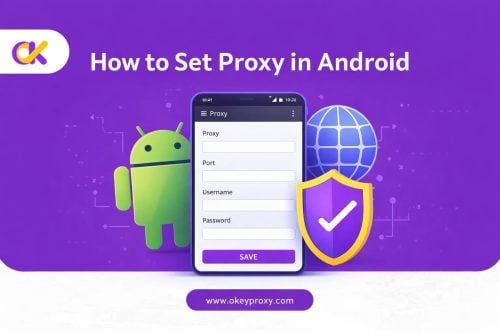
Android supports manual proxy configuration within individual Wi-Fi network settings, but this applies only to that specific Wi-Fi connection and may not cover all app traffic (especially apps using direct sockets).
Method A: Built-in Wi-Fi Settings (Per-network, limited coverage)
- Abrir Ajustes → Conexiones (o Redes e Internet) → Wi-Fi.
- Pulse el botón icono de engranaje (or long-press) next to your connected network.
- Toque View more o Opciones avanzadas (this varies by Android version and manufacturer).
- Pulse el botón Proxy dropdown and change it from Ninguno a Manual.
- Introduzca el Proxy hostname (your SOCKS5 server address) and Puerto proxy (e.g., 1080).
- Toque Guardar.
Limitation: Android’s built-in proxy settings at the Wi-Fi level have inconsistent SOCKS5 support across manufacturers. Many apps (especially those using their own network stacks) will ignore these settings.
Method B: Using ProxyDroid App (System-wide, requires root)
- Instale ProxyDroid from the Google Play Store (requires a rooted device).
- Open ProxyDroid and enter the Anfitrión, Puerto, and set Tipo de proxy a SOCKS5.
- If required, enter your Nombre de usuario y Contraseña.
- Toggle Auto-connect on and tap the main switch to enable the proxy.
Method C: Using a VPN-based Proxy App (No Root Required — Recommended)
Apps like v2rayNG o NekoBox can wrap your SOCKS5 proxy within a local VPN tunnel, providing system-wide coverage without root access. Configure the SOCKS5 details within the app’s server settings and enable the VPN profile when prompted by Android.
Advanced SOCKS5 Configuration Options
Once you have the basic connection working, you can fine-tune your setup for better security and performance.
Authentication: Username and Password
While some proxies use IP Whitelisting (where access is granted based on your current IP address), most professional SOCKS5 setups require a username and password — known as “User:Pass Authentication.” Always double-check these credentials; a single typo will result in a “407 Proxy Authentication Required” error. When copying credentials from your provider’s dashboard, watch out for accidental leading or trailing spaces.
DNS Leaks: The Silent Privacy Killer
Even with your IP masked, your browser may still send DNS requests through your regular ISP — a vulnerability known as a “DNS leak.” In your SOCKS5 configuration (especially in Firefox or ZeroOmega), always enable the option to "Proxy DNS al utilizar SOCKS v5". This ensures that the proxy server handles all DNS lookups, keeping your browsing activity truly private. You can verify this by visiting dnsleaktest.com after configuring your proxy.
Validation: Did the IP Actually Change?
After configuring your proxy, always verify the result. Visit a site like whatismyip.com o ipleak.net. If the IP address and location shown match your proxy’s details — and not your real physical location — your SOCKS5 configuration is working correctly.
Common Use Cases for SOCKS5 Proxies
Why do people go through the trouble of SOCKS5 configuration? Because it unlocks capabilities that standard internet connections cannot provide.
- Gestión de redes sociales:Manage multiple accounts on Instagram, TikTok, or Facebook without triggering “suspicious activity” flags. SOCKS5 provides unique, clean residential IPs that appear as genuine user traffic.
- SEO and Web Scraping: Collect large volumes of data from Google or e-commerce sites. Using a rotating SOCKS5 configuration lets you bypass rate limits and anti-scraping mechanisms.
- Verificación de anuncios: View your ads exactly as they appear to users in other countries to ensure they are not being hijacked by fraudsters or displayed incorrectly.
- Streaming y juegos: Because SOCKS5 supports UDP, it is the best proxy choice for gamers looking to reduce latency or access region-locked game servers.
- Supervisión del comercio electrónico: Track prices and inventory across global markets anonymously to stay ahead of the competition.
Troubleshooting SOCKS5 Configuration Issues
Sometimes, even with the correct settings, things go wrong. Here is how to resolve the most common issues:
- Credential Errors (407 Authentication Required): Ensure there are no extra spaces when you copy-paste your username or password. Check your provider’s dashboard to confirm the credentials are still active and have not expired.
- “Proxy Server is Not Responding”: This usually means the port is blocked by your local firewall, or the proxy server itself is offline. Try switching to a different IP or port from your provider’s pool, and check that your local firewall is not blocking outbound traffic on port 1080.
- DNS Leaks (Real location showing): If your real IP or location appears on a leak test, ensure “Proxy DNS when using SOCKS v5” (or “Remote DNS”) is enabled in your configuration tool. This is the most common cause of failed anonymity.
- Connection Drops (Residential Proxies): If you are using residential proxies, the IP may have gone offline, as these belong to real home users with dynamic connections. Simply refresh your proxy list to obtain a new sticky or rotating IP from your provider’s dashboard.
- IP Whitelist Issues: If you are using IP-based authentication instead of username/password, ensure your current local IP address is correctly added to your provider’s whitelist. Your local IP changes every time you reconnect to the internet on most home connections.
- Application Ignoring Proxy Settings: Some applications use their own network stack and bypass OS-level proxy settings entirely. In this case, use a proxifier tool (Proxifier on Windows/macOS, ProxyChains on Linux) to force the application’s traffic through the SOCKS5 tunnel.
Conclusión
Mastering SOCKS5 configuration is the key to unlocking the full potential of the web, whether for business or personal privacy. While the manual setup varies by device and platform, the core principles remain consistent: use high-quality IP sources, configure the correct port, enable DNS-over-proxy to prevent leaks, and always verify your IP after setup. By choosing a reliable provider like OkeyProxy and following the accurate, platform-specific steps outlined in this guide, you can ensure a fast, stable, and truly anonymous connection for any task in 2026.