It’s release time. You’re ready—address saved, payment set, finger on refresh. The countdown hits zero… and instantly: “Sold Out.” 😭
The latest Labubu limited edition vanished in a blink. It’s not that you were too slow—it’s that you weren’t competing with humans. Behind most instant sell-outs is a Labubu bot, snapping up stock in milliseconds. In today’s designer toy drops, manual clicking simply can’t keep up. If you want a real chance in 2026, you need to understand how Labubu bots work—and why they dominate every release.
What are Labubus? (And are they still hot in 2026?)
If you’ve walked through any major shopping district in Bangkok, Shanghai, or Singapore recently, you’ve seen the long ears and the mischievous, jagged-toothed grin. Created by artist Kasing Lung as part of “The Monsters” family, Labubu has transcended the definition of a “toy.”
By 2026, Labubu has become a global cultural phenomenon. It is the “Blue Chip” of the designer toy world. What started as a niche collectible has evolved into a high-fashion icon, with collaborations spanning luxury brands and streetwear giants. Because Pop Mart (the primary distributor) utilizes a “blind box” and “limited drop” model, the scarcity is engineered. Labubu represents the perfect intersection of art, investment, and community. Whether it’s the plush pendants or the 1000% Mega Space versions, the demand in 2026 is higher than ever, making every release a digital battlefield. 🎨🧸

What is a Labubu Bot and How Does It Work?
A Labubu Bot is a specialized piece of software or script designed to automate the entire purchasing process on platforms like Pop Mart’s official website, Shopify-based stores, or regional shopping apps.
The Core Mechanics
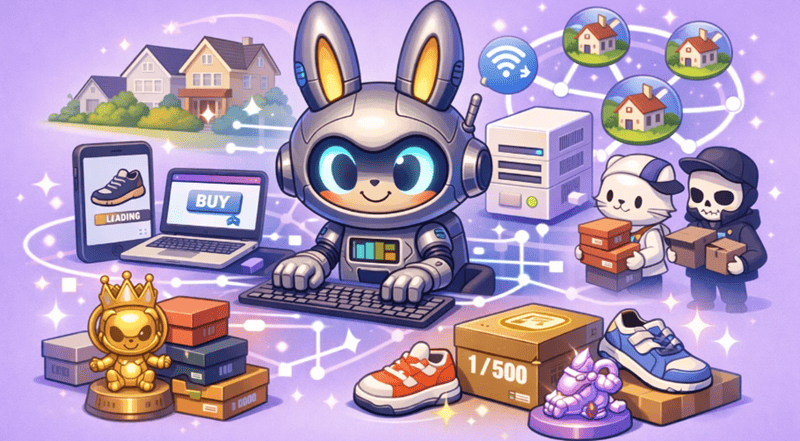
A bot doesn’t “see” the website the way you do. Instead, it communicates directly with the site’s backend or uses a headless browser to perform actions at lightning speed. Here’s how the process typically works:
- Monitoring: The bot constantly monitors the product page, waiting for the exact millisecond the “Buy Now” button becomes active.
- Adding to Cart: As soon as stock is detected, it immediately adds the item to the cart.
- Checkout: The bot auto-fills shipping and payment details using pre-configured profiles.
- Completion: It submits the order before a human could even finish loading the product page.
While it simulates human behavior, the bot operates with millisecond precision, eliminating the “human errors” of slow clicks or shaky fingers.
Why You Can’t Compete Without a Bot (and Proxies)
In today’s hyper-competitive release environment, relying on a “lucky thumb” is almost guaranteed to end in disappointment. Here’s why experienced collectors have turned to automation:
Speed Is Everything
A fast human might take 3–5 seconds to notice stock, add an item to the cart, and begin checkout. A well-configured Labubu bot can complete the same actions in milliseconds. In many cases, by the time your browser finishes rendering the “Add to Cart” button, automated checkouts are already being processed. 🏎️
Aggressive Anti-Bot Protection
Pop Mart and similar retailers deploy advanced security systems such as Akamai, Cloudflare, or DataDome to protect limited releases. These systems monitor behavior patterns like rapid refreshes, repeated requests, and IP reputation. If you refresh too frequently from a single home IP, you may encounter 403 errors, soft blocks, or CAPTCHA loops—effectively removing you from the race before checkout even opens.
The Real Competitive Advantage
Using a bot alone isn’t enough. The real edge comes from pairing automation with high-quality residential proxies. This setup allows collectors to appear as legitimate individual buyers, helping them compete not only with casual manual shoppers, but also with professional resellers. For ultra-limited drops—such as “Secret” editions or 1-of-500 releases—automation is often the difference between securing a piece and seeing it instantly relisted at 5–10× retail price.

The Secret Ingredient: Why Proxies Are Essential for Labubu Botting
If the bot is the engine, then proxies are both the fuel and the camouflage.
Retailers are highly vigilant about tracking request patterns from individual IP addresses. If you’re running 10 tasks on a single bot using your home Wi-Fi, the retailer’s security system will quickly spot 10 identical requests coming in from the same IP at the exact same time. The result? Your home IP gets blacklisted in under 5 seconds. Not only will you miss the drop, but you might also find yourself locked out of the site for days or even weeks.
The Power of Residential Proxies (The Professional Choice) 🌐
This is where residential proxies come into play as the game-changer. Unlike data center IPs, which are easily flagged, residential proxies are real IP addresses assigned by ISPs to actual households.
Hiding Your Identity
Each bot task is assigned a unique residential IP. To the Pop Mart server, it looks like 10 different users from 10 separate homes are attempting to purchase the same toy. This makes your traffic nearly invisible to sophisticated anti-bot shields.
Global “Teleportation”
Labubu drops are often region-specific, with a certain version available in one country first, and then rolling out to others. Using a residential proxy allows you to “teleport” your bot to different locations. For example, by using a Bangkok-based IP, you can bypass geo-restrictions and participate in local drops as though you’re in Thailand.
为什么选择 OkeyProxy?
For serious Labubu collectors, OkeyProxy is the go-to solution. With over 150 million real residential IPs and a lightning-fast 0.6s response time, OkeyProxy ensures that your bot maintains a human-like presence while also delivering the speed needed to bypass even the toughest security measures.
What You Need to Secure Labubu Drops
To successfully bot a Labubu release, there are generally two paths you can take:
the Do-It-Yourself (DIY) developer route或 plug-and-play commercial bot route.
Each comes with its own learning curve, cost, and level of control.
Option 1: Custom Scripts (The Developer Route)
If you have technical experience, building your own bot gives you maximum flexibility and control. Here’s what a typical setup looks like:
Core Requirements
- Python (Latest Stable Version): Python is the backbone of most modern automation workflows due to its flexibility and ecosystem.
- Playwright (Browser Automation Framework): Playwright is a modern automation library capable of handling heavy JavaScript frameworks commonly used on Pop Mart and Shopify-based sites. Compared to older tools, it offers better stealth, stability, and browser fingerprint consistency.
- Browser & Dependencies: Playwright bundles its own browser binaries, but keeping your system browser and dependencies updated ensures smoother debugging and compatibility.
- 住宅代理: A rotating pool of residential IPs (such as those from OkeyProxy) is essential to prevent IP bans and distribute requests naturally.
- Pop Mart Accounts: At least one verified, aged account is required. Running multiple accounts with unique profiles (names, addresses, payment methods) can significantly improve success rates—but also increases operational complexity.
Simplified Workflow Overview
- Launch a Playwright session through a residential proxy
- Log into a Pop Mart account
- Monitor the product page or relevant backend signals
- Detect when the “Buy” or “Add to Cart” button becomes active
- Execute checkout instantly using pre-filled profiles
This approach requires ongoing maintenance, especially when Pop Mart updates its frontend or security logic.
Option 2: Ready-Made Bots (The Plug-and-Play Route)
If you’re not a developer, commercial bots offer a faster entry point—at the cost of flexibility and subscription fees.

Popular Options
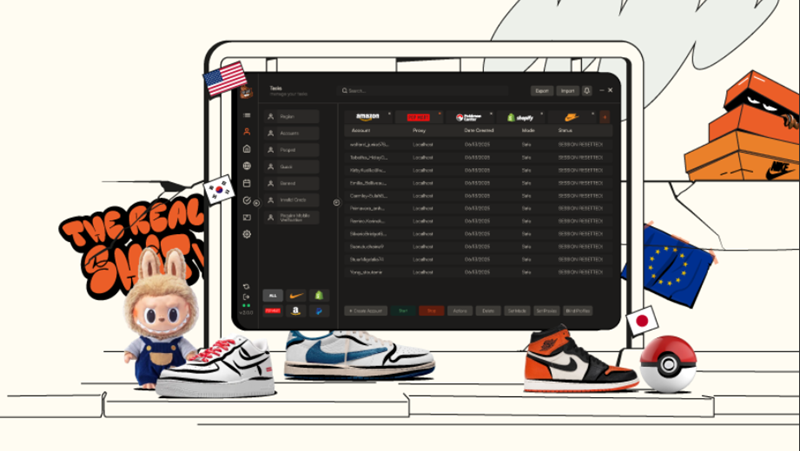
- NSB (NikeShoeBot): Despite its name, NSB supports many Shopify-based retail sites, including designer toy drops. It’s actively maintained and widely used across multiple niches.
- TSB (The Shit Bot): A long-standing favorite in the hype community, TSB supports a broad range of platforms and offers advanced task automation.
- Pop Mart-Specific Add-Ons & Scripts: Some developers sell private or semi-private Pop Mart modules through Discord or Twitter. These tools often integrate with existing bots and focus on specific regional drops.
⚠️ Note: Availability, reliability, and long-term support vary greatly with niche tools—use caution and vet sources carefully.
Common Pitfalls: Why Your Bot Might Still Fail
Even with automation, success is never 100% guaranteed. If you’re consistently seeing “Checkout Failed” or getting blocked before payment, the issue is usually not the bot itself—but one of the following mistakes:
1. Using Cheap Data Center IPs (The #1 Killer)
This is the most common and most costly error. Data center IPs come from cloud providers like AWS or Google Cloud. Pop Mart’s security stack (often powered by Cloudflare) can instantly recognize these IPs as non-residential.
Result: Your requests are flagged before the product page even finishes loading.
Fix: Always use 优质住宅代理, which are tied to real ISP networks and blend in with normal shopper traffic.
2. Unrealistic Request Frequency
More speed does not always mean more success. Bots that send requests every few milliseconds stand out immediately.
Result: Abnormal traffic patterns trigger rate limits, captchas, or silent blocks.
Fix: Use human-like delays and smart monitoring logic. Professional setups prioritize timing precision, not brute-force spam.
3. Low Account Trust (“Account Weight”)
Brand-new Pop Mart accounts with zero purchase history carry very little trust.
Result: Even if your bot adds the item to cart, checkout may fail during payment or confirmation.
Fix: Use aged accounts with prior successful purchases. A clean, organic history dramatically increases pass rates.
4. Slow Proxy Latency
A fast bot is useless if the network layer is slow.
If your proxy takes 1–2 seconds to respond, your automation instantly loses its edge—especially during sub-second sellouts.
Reality Check: In 2026, those extra milliseconds often determine whether you receive a “Order Confirmed” email or a “Sold Out” message.
Fix: Choose residential proxies with low latency and stable routing close to the drop region.
Best Practices Summary: How to Maximize Your Success Rate ✅
To give your Labubu bot the best possible chance:
- ✅ Use residential proxies only (never cheap data center IPs)
- ✅ Match proxy location to the drop region
- ✅ Tune request delays to mimic real users
- ✅ Run aged, trusted accounts with clean histories
- ✅ Prioritize low-latency proxy infrastructure
- ✅ Test your full setup before release day—never live-test on drop time
Automation is powerful, but in competitive drops, infrastructure quality and operational discipline matter more than raw speed.
Conclusion: A Battlefield for the Brave (and Technical)
The toy market in 2026 is no longer just about who wakes up earliest to stand in line; it is a high-speed digital chess match. The Labubu Bot has changed the rules of the game forever. While it might seem unfair to the casual collector, the reality is that technology is the only way to bypass the massive waves of professional scalpers who have been using these tools for years.
To win, you need to be prepared. Combine a powerful bot with the stealth of Residential Proxies, stay updated on the latest anti-bot changes, and treat every drop like a technical operation. In the world of Labubu, fortune favors the fast—and the well-connected.