
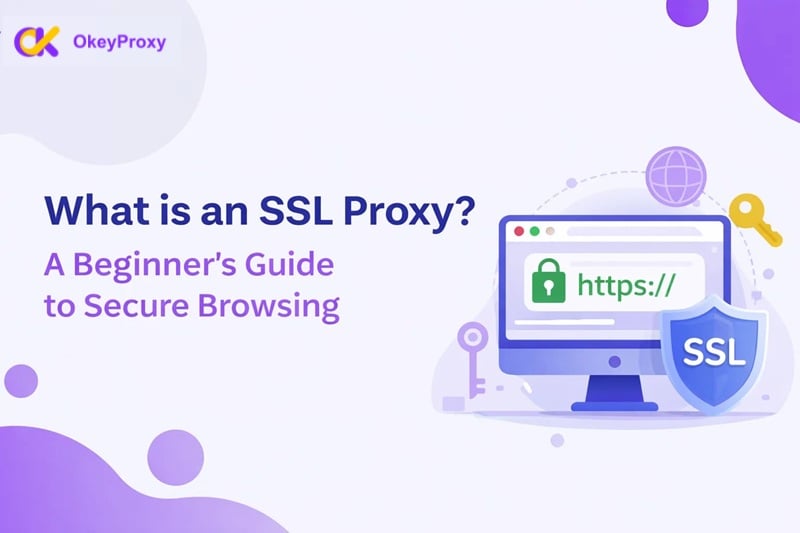
Have you ever noticed that little “padlock” icon sitting right next to a website’s URL in your browser’s address bar? For most of us, that symbol is a comforting sign that our connection is private and our data is safe. But what happens when you need to use a proxy for work, privacy, or data collection while keeping that security intact? This is where the concept of an SSL proxy comes into play.
In this guide, we are going to break down the fundamental question—что такое ssl-прокси—in a way that anyone can understand. You won’t need to write a single line of code or be a cybersecurity expert. Think of this as your plain-English manual to one of the most important tools in modern internet security.
What is an SSL Proxy? Demystifying the Terminology
Before we dive into the mechanics, let’s clear up the “alphabet soup” of technical names. You might hear people use terms like SSL proxy, TLS proxy, or HTTPS proxy. For a beginner, this can be incredibly confusing, but here is a secret: they are mostly talking about the same thing.
SSL vs. TLS: The History Lesson
SSL (Secure Sockets Layer) is actually the old name for this security technology. The modern, more secure version used today is technically called TLS (Transport Layer Security). However, because “SSL” became such a popular term over the last two decades, most people and companies still call it an SSL proxy. If you see “TLS Proxy,” just know it’s simply the updated version of the same idea.
SSL Proxy vs. HTTPS Proxy
These two terms are essentially interchangeable. SSL is the security technology, while HTTPS is the protocol you see in your browser (Hypertext Transfer Protocol over SSL). Therefore, an HTTPS-прокси is a server that uses SSL/TLS to keep your connection private. It acts as a secure middleman between your computer and the vast world of the internet.
How Does an SSL Proxy Work?
To understand the technical side of что такое ssl-прокси, let’s use a simple analogy involving mail and security. Imagine you are sending a secret letter to a friend, but you are worried about what might happen to it during delivery.
The Analogy: The Trusted Security Guard
Normally, when you visit an encrypted website, you put your letter in a locked box. Only you and the website have the key. No one in the middle can see what you wrote. However, if that website is actually hiding a “bomb” (malware), you wouldn’t know until you opened the box at home.
An SSL proxy acts like a trusted security guard with a duplicate key. When you send your locked box, the guard intercepts it, opens it with their key, and checks to make sure the letter is safe and doesn’t contain anything harmful. Once they see everything is okay, they put the letter into a new locked box, lock it with a different key, and send it to the final recipient. This ensures that the journey is safe from start to finish.
The 3-Step Process
In technical terms, the SSL proxy follows this sequence every time you click a link:
- Step 1: Intercept – The proxy server catches your request before it reaches the website. It establishes a secure “tunnel” between your computer and the proxy.
- Step 2: Inspect – The proxy decrypts the data (opens the box) to scan for viruses, malware, or restricted content. This is known as “Deep Packet Inspection.”
- Step 3: Forward – After confirming the data is safe, the proxy re-encrypts it and establishes a second secure tunnel between itself and the destination website.
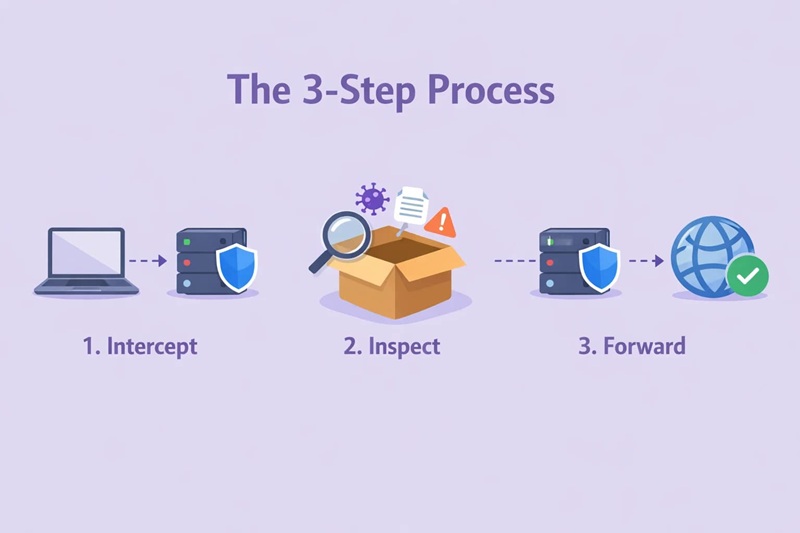
By acting as this “Man-in-the-Middle” in a safe, controlled way, the proxy ensures that your data remains invisible to hackers while still being checked for quality and safety by your own systems.
Why Do Beginners Need an SSL Proxy? (Key Benefits)
Now that you know что такое ssl-прокси and how it functions, you might be wondering: “Why should I care?” Even if you aren’t running a giant tech company, these proxies offer several life-changing benefits for regular users.
🛡️ Enhanced Privacy
Every time you visit a website, that site sees your “Home Address” (your IP address). An SSL proxy hides your real IP and replaces it with its own. This means you can browse the web anonymously, but unlike a regular proxy, your data remains encrypted and safe from prying eyes on your local network.
🚫 Bypassing Geoblocks and Filters
Have you ever seen a message saying, “This content is not available in your country”? An SSL proxy can help you bypass these digital borders. By choosing a proxy located in a different country, you can access the content you want while maintaining the high security of an HTTPS connection.
🔍 Identifying Malicious Content
Because an SSL proxy can “look inside” the encrypted traffic, it can catch malicious code that a standard firewall might miss. This is a huge benefit for families or small businesses that want an extra layer of defense against phishing attacks and viruses.
⚡ Improved Performance
Large websites often use a type of SSL proxy to handle the “heavy lifting” of encryption. By doing the hard work of locking and unlocking the boxes, the proxy allows the main web server to run faster, resulting in quicker load times for you as the visitor.
What Can You Use an SSL Proxy For?
While privacy is a major factor, the practical uses of an SSL proxy extend into many different areas of work and play.
- Web Data Scraping: If you are a researcher or business owner trying to collect public data from websites, an SSL proxy allows you to gather that info without being blocked, all while keeping your connection secure.
- Account Management: For those who manage multiple social media or business accounts, using different SSL proxies ensures that your accounts aren’t “linked” together by the platform, preventing accidental bans.
- Business Automation: Marketing experts use these proxies to automate tasks like checking ad placements or monitoring competitor prices across different global markets.
The Different Types of SSL Proxies
Not all proxies are created equal. Depending on where the IP address comes from and how the proxy sits in the network, you will find several different types.
By Direction: Forward vs. Reverse
- The “Protective Shield” (Forward SSL Proxy): This sits in front of you (the client). It protects your privacy, hides your IP, and blocks you from accidentally visiting dangerous sites.
- The “Front Desk” (Reverse SSL Proxy): This sits in front of a website (the server). It helps the website handle thousands of visitors at once and protects the site’s backend from hackers.
By IP Source: Where does the “Identity” come from?
- Residential SSL Proxies: These use IP addresses assigned to real homes by Internet Service Providers. They are the most trusted type because you look like a real person browsing from their living room.
- Datacenter SSL Proxies: These come from powerful servers in a data center. They are very fast and affordable but are more likely to be recognized as a “bot” by some websites.
- Mobile SSL Proxies: These use IPs from mobile phone networks (like 4G or 5G). They are incredibly hard to block but can be more expensive.
Is Using an SSL Proxy Safe?
This is the most important question for any beginner. The answer depends entirely on who is providing the proxy. You should never use a “free” SSL proxy. Running these servers costs money; if a provider isn’t charging you, they are likely “charging” you by stealing your data, passwords, or browsing history.
The Professional Choice: OkeyProxy
To stay safe, you need a transparent and professional provider you can truly trust. This is where OkeyProxy comes in. Recognized as a top HTTP and SOCKS5 proxy provider что Удовлетворит все ваши потребности в прокси, OkeyProxy offers a massive network of over 150 million high-quality IPs.
Whether you are looking for жилой или центр обработки данных solutions, their premium infrastructure ensures your connection is fast, stable, and secure. By using such a reputable provider, you appear as a genuine user rather than a script, which makes your browsing experience much smoother and significantly reduces those annoying “I am not a robot” tests.
Ready to experience a more professional proxy service?
From individual privacy to large-scale business automation, OkeyProxy is designed to handle it all.
👉 Get Started with OkeyProxy – The Top HTTP & SOCKS5 Provider Today!
SSL Proxy vs. Regular Proxy: A Quick Comparison
If you are still a bit fuzzy on the difference, think of a regular proxy as sending a postcard—anyone at the post office can read your message. An SSL proxy is like sending a locked safe inside an armored truck.
| Характеристика | Regular (HTTP) Proxy | SSL/HTTPS Proxy |
|---|---|---|
| Уровень конфиденциальности | Low (Only hides IP) | High (Hides IP + Protects Data) |
| Data Security | None (Data is visible) | Encrypted (Data is locked) |
| Trust from Websites | Умеренный | Очень высокий |
| Лучший пример использования | Simple, non-sensitive tasks | Shopping, Logging in, Scraping, Business |
Conclusion: Your Gateway to a Safer Web
In the digital landscape of 2026, privacy is no longer a luxury—it’s a necessity. Understanding что такое ssl-прокси is the first step toward taking control of your online footprint. By combining the anonymity of a proxy with the heavy-duty encryption of SSL/TLS, you create a digital environment that is both open and incredibly secure.
Whether you are a beginner looking to browse more privately or a professional aiming to scale your business automation, an SSL proxy is your ultimate digital bodyguard. Remember to always prioritize your safety by choosing trusted, residential providers like OkeyProxy, and you’ll be well on your way to a faster, safer, and more borderless internet experience.