

Immaginate per un momento di dover insegnare a un visitatore proveniente da una galassia lontana lontana cosa sia una "mela". Questo alieno è incredibilmente intelligente, ma non parla una parola di inglese, o di qualsiasi altra lingua umana, se è per questo. Tuttavia, hanno un superpotere: sono dei geni assoluti con i numeri. Possono calcolare traiettorie complesse nella loro testa in un batter d'occhio, ma la parola "rosso" o "dolce" non significa nulla per loro.
Per spiegare una mela, decidete di usare un sistema di coordinate. Dite all'alieno: "Sull'asse della dolcezza, questo oggetto è un 7. Sull'asse della croccantezza, è un 8. Sullo spettro dei colori, si trova alla coordinata 650 (rosso)".
Improvvisamente, l'alieno "capisce". Non conosce la parola mela, ma capisce la sua posizione matematica rispetto a un "limone" o a una "roccia". Questa è l'essenza del significato della mappatura di un testo per un'intelligenza artificiale. È il processo di prendere il nostro linguaggio umano, disordinato, emotivo e complesso, e tradurlo in una "mappa" di numeri (vettori) che un computer può calcolare.
Cosa significa "mappare un testo" in termini semplici?
Quando parliamo del significato della mappatura di un testo per un'intelligenza artificiale, descriviamo la trasformazione del linguaggio in una "mappa" spaziale.
Nel nostro cervello umano, una parola come "Gatto" fa scattare un'immagine di pelliccia, baffi e forse un ricordo di un animale domestico. Nel "cervello" di un'intelligenza artificiale non ci sono immagini, ma solo uno spazio multidimensionale. Immaginatelo come un'enorme stanza in 3D (o addirittura in 10.000 dimensioni). Ogni parola esistente ha un posto specifico in quella stanza.
La chiave di questa mappa è la prossimità. In un sistema di IA ben mappato:
- "Gatto" e "Cane" sono seduti l'uno accanto all'altro perché sono entrambi animali domestici.
- "Gatto" e "Gattino" sono praticamente sulla stessa poltrona.
- "Gatto" e "Smartphone" sono ai lati opposti della stanza perché non hanno quasi nulla in comune.
Comprensione umana e mappatura dell'intelligenza artificiale
| Dimensione | Comprensione umana (Testo) | Mappatura AI (Vettori / Matematica) |
|---|---|---|
| Unità di base | Parole, frasi e sentimenti | Elenchi di numeri (ad esempio, [0,12, -0,5, 0,8]) |
| Logica | "Una mela è un frutto". | "Mela" e "Frutta" presentano un'elevata somiglianza matematica |
| Elaborazione | Lettura, empatia e contesto | Moltiplicazione di matrici e probabilità |
| Obiettivo | Comunicare o sentire | Per prevedere la prossima coordinata logica |
Di cosa è fatta una "carta di testo"? (Forme comuni di mappatura)
La "mappatura" non è una singola azione, ma un insieme di strumenti. A seconda di ciò che l'IA deve fare, la "mappa" può avere un aspetto diverso. Ecco i cinque modi più comuni in cui l'IA mappa il nostro testo:
① Tokenizzazione (suddivisione del testo)
Questo è il "Lego" stage. Prima che un'intelligenza artificiale possa mappare una frase, la spezza in pezzi più piccoli, chiamati token.
Esempio: "Amo il sole" diventa ["Io", "amore", "sole"].
② Incorporazione (da testo a numeri)
Questa è la forma più famosa di mappatura. Assegna a ogni token un insieme di coordinate in quell'enorme "stanza" di cui abbiamo parlato.
Esempio: La parola "Re" potrebbe essere mappata su un punto nello spazio. Se si sottraggono le coordinate di "Uomo" da "Re" e si aggiungono quelle di "Donna", la mappa dell'IA punterà letteralmente verso le coordinate di "Regina".
③ Tagging (da testo a etichette)
In questo caso, l'intelligenza artificiale mappa le parole in base al loro ruolo grammaticale o strutturale.
Esempio: Nella frase "Apple sta assumendo", l'IA mappa "Apple" sull'etichetta [Organizzazione] anziché su [Frutta].
④ Estrazione di informazioni (da testo a struttura)
In questo modo i paragrafi disordinati vengono trasformati in tabelle ordinate.
Esempio: Mappatura di un'e-mail di conferma del volo in una mappa strutturata di: Data: 10 ottobre, Destinazione: NYC, Gate: B2.
⑤ Mappatura delle caratteristiche (da testo a modelli)
L'IA mappa il testo a "vibrazioni" o stili specifici.
Esempio: Esempio: Mappatura di un'e-mail lunga su un modello "Formale" o su un modello "Sarcastico".
Come viene creata questa "mappa"? (Passo dopo passo)
Creare una mappa testuale è come costruire un sistema GPS per il pensiero umano. Avviene in tre sofisticate fasi:
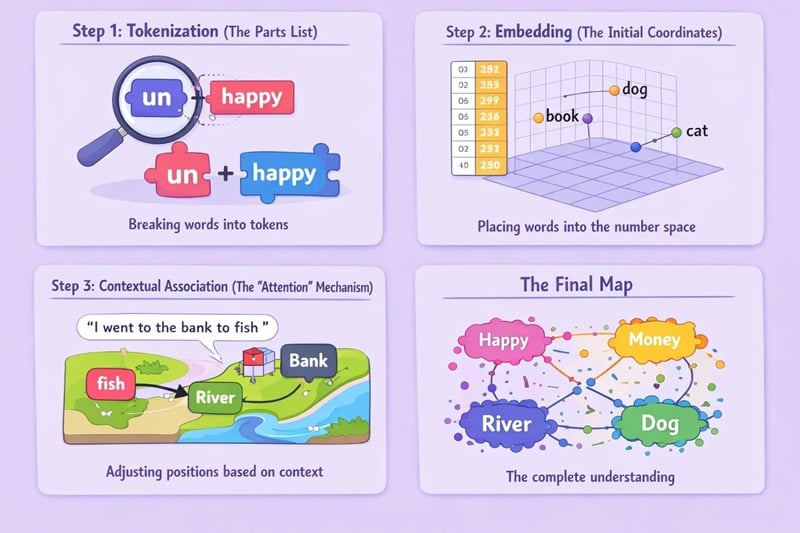
Fase 1: Tokenizzazione (l'elenco delle parti)
L'intelligenza artificiale decostruisce innanzitutto la frase. Non guarda solo alle parole, ma anche ai prefissi e ai suffissi. Ad esempio, "infelice" potrebbe essere suddiviso in "un" e "felice". Questo aiuta l'IA a capire che "un" di solito significa "l'opposto di" ovunque appaia sulla mappa.
Fase 2: Incorporazione (le coordinate iniziali)
L'intelligenza artificiale cerca ogni token nel suo "dizionario". Ma non si tratta di un normale dizionario, bensì di una gigantesca tabella di numeri. Ogni parola riceve una posizione iniziale. Tuttavia, queste posizioni sono statiche: non sanno ancora chi sono i loro vicini.
Fase 3: Associazione contestuale (il meccanismo di "attenzione")
Questa è la "magia" delle moderne IA come ChatGPT. Utilizza una cosa chiamata attenzione. Pensate a un GPS che si aggiorna in tempo reale.
- Se il testo dice: "Sono andato a pescare sulla riva", la parola "pescare" invia un segnale a "riva".
- L'IA sposta quindi le coordinate di "banca" da "denaro" a "fiume".
- Questa mappatura dinamica assicura che l'intelligenza artificiale "capisca" il significato specifico della parola in quella determinata frase.
Un semplice esempio: Mappare il testo passo dopo passo
Vediamo come un'IA mappa la frase: "La mazza ha sorvolato il campo".
1️⃣ Tokenizzazione: [Il pipistrello volò sopra il campo].
2️⃣ Mappatura iniziale: "Bat" potrebbe essere una mazza da baseball o un animale. La sua coordinata è attualmente al "centro".
3️⃣ Mappatura contestuale:
- L'intelligenza artificiale vede la parola "volato".
- "Flew" è un vicino di "ali", "cielo" e "uccelli".
- L'IA applica l'attenzione: Avvicina la coordinata "pipistrello" alla sezione "animali/mammiferi" della mappa e la allontana dalla sezione "attrezzature sportive".
4️⃣ Risultato finale: L'IA ha ora una mappa matematica in cui "pipistrello" si trova vicino a "creature notturne".
Perché ci preoccupiamo di mappare il testo?
La mappatura sembra un lavoro molto pesante dal punto di vista matematico. Perché non lasciare che l'intelligenza artificiale legga le parole come facciamo noi? Perché la mappatura consente all'IA di fare "miracoli" che la semplice corrispondenza delle parole chiave non può fare:
- Ricerca semantica: Se si cerca "abbigliamento per neonati", un'intelligenza artificiale mappata sa di mostrare "vestiti per neonati". Anche se le parole sono diverse, le loro posizioni sulla "mappa" sono quasi identiche.
- Analisi del sentimento: L'intelligenza artificiale può mappare il "tono" di una recensione. Può capire se un cliente è sinceramente felice o se usa "coordinate sarcastiche" per lamentarsi di un prodotto.
- Traduzione universale: Questo è l'uso più bello. L'IA mappa "Apple" (inglese) e "Pingguo" (cinese) nella stessa identica coordinata della sua mappa concettuale. Per l'IA si tratta dello stesso punto, solo che ha due nomi diversi nelle lingue umane.
Cosa è necessario per costruire queste mappe?
Per costruire una mappa dell'intero linguaggio umano, un'intelligenza artificiale deve "leggere" quasi tutto ciò che è stato scritto: miliardi di pagine web, libri e articoli. Questi dati sono chiamati "dati di addestramento".
Tuttavia, raccogliere questi dati non è sempre facile. Molti ricercatori e sviluppatori si trovano di fronte a un ostacolo significativo: Accesso ai dati.
Per rendere la "mappa" di un'intelligenza artificiale completa e imparziale, i ricercatori devono raccogliere testi da tutto il mondo. Tuttavia, molti siti web hanno restrizioni o blocchi regionali che impediscono un facile accesso a questi dati. È qui che strumenti affidabili come OkeyProxy entrano in gioco. Utilizzando deleghe residenzialiGli sviluppatori di IA possono accedere a dati testuali diversificati e globali senza essere bloccati dai server, assicurando che la loro "mappa" dell'IA sia il più accurata e completa possibile.
Equivoci comuni: L'IA mi "capisce"?
È facile lasciarsi trasportare e pensare che l'IA stia davvero "pensando". Dobbiamo essere sinceri: un'IA non "sa" cosa si prova con l'amore di una madre o che sapore ha una fragola. Sa solo che quelle parole hanno relazioni matematiche specifiche con altre parole.
- ❌ Mappatura ≠ Traduzione: È il processo che consente la traduzione.
- ❌ Mappatura ≠ Etichettatura: L'etichettatura è solo un piccolo tipo di mappa.
- ❌ Mappatura della coscienza: L'intelligenza artificiale non sta "pensando", ma sta calcolando la distanza più breve tra due punti in un'enorme nuvola di dati.
- ✅ Mappatura = Rappresentazione matematica: È il ponte tra la poesia umana e la logica del computer.
Mappare un testo equivale ad addestrare un'intelligenza artificiale?
Questo è un punto di confusione frequente. Vedetela in questo modo: L'addestramento è il lungo e costoso processo di costruzione della "stanza delle mappe" e di insegnamento all'IA di dove vanno tutti i mobili. La mappatura è ciò che l'IA fa ogni volta che si digita un messaggio nella casella.
| Caratteristica | Addestramento di un'intelligenza artificiale | Mappatura di un testo |
|---|---|---|
| Quando succede? | Mesi prima del rilascio dell'IA | Ogni volta che si preme "Invio" |
| Cambia l'IA? | Sì, crea il "cervello" dell'IA | No, utilizza semplicemente il "cervello" esistente |
| Costo delle risorse | Milioni di dollari in elettricità e chip | Frazioni di centesimo |
| Obiettivo | Imparare le relazioni tra le parole | Posizionare una frase specifica sulla mappa |
Conclusione: La mappatura è la base dell'intelligenza artificiale
Senza la mappatura del testo, l'intelligenza artificiale sarebbe una macchina cieca, che non vede altro che un'accozzaglia di lettere e simboli. La mappatura è ciò che dà all'IA la sua "visione". Trasforma le nostre storie, le nostre domande e i nostri dati in un paesaggio logico in cui il computer può finalmente incontrarci a metà strada.
💡 Appendice: Glossario per non addetti ai lavori della mappatura del testo dell'IA
Se siete ancora un po' confusi con il linguaggio tecnico, ecco un rapido "cheat sheet" per aiutarvi a padroneggiare la conversazione:
| Termine | Definizione semplice | Vedila come... |
|---|---|---|
| Mappatura | Il processo complessivo di trasformazione di un testo umano in un formato matematico. | Disegnare una mappa in cui ogni parola ha la sua coordinata GPS. |
| Tokenizzazione | Suddivisione di una frase in pezzi più piccoli (parole, prefissi o caratteri). | Smontare un castello Lego in singoli mattoncini. |
| Incorporazione | Un modo specifico di rappresentare le parole come un elenco di numeri (vettori). | Assegnare un "numero di identificazione sociale" a una parola che ne descrive la personalità. |
| Vettore | Il nome matematico dell'elenco di numeri che rappresenta una parola. | La latitudine e la longitudine esatte di una parola sulla mappa dell'IA. |
| Attenzione | Un meccanismo che aiuta l'intelligenza artificiale a concentrarsi su quali parole di una frase sono più rilevanti l'una per l'altra. | Un riflettore che si accende sulla parola "fiume" quando vede la parola "banca". |
| PNL | Elaborazione del linguaggio naturale - il campo dell'IA incentrato sul linguaggio umano. | Il "Dipartimento inglese" del mondo dell'intelligenza artificiale. |
| Semantico | Fare riferimento al significato delle parole piuttosto che alla loro semplice ortografia. | Capire che "casa" e "casa" sono la stessa cosa, anche se hanno un aspetto diverso. |