
You’re at a crossroads. You’ve just finished building a high-performance web crawler, or perhaps you’re setting up a suite of social media accounts or a sneaker bot for the next limited drop. You know you need a proxy to hide your identity and avoid being blocked, but then you see the options: Residential, Datacenter, ISP, and Mobile. The price tags vary wildly, and the technical jargon is everywhere. You find yourself asking: “Which one offers the best value for my specific task? Which one is the least likely to get me banned?”
In 2026, the stakes are higher than ever. Anti-bot systems now use advanced behavioral fingerprints and IP reputation scores — known as Trust Scores — to identify automated traffic. Choosing the wrong proxy type doesn’t just slow you down; it gets your IP blacklisted and your accounts terminated. This guide breaks down the fundamental difference between residential, datacenter, ISP, and mobile proxies so you can invest your budget where it actually delivers results.
The 60-Second Summary Table
If you’re in a hurry to get your project running, here is a quick-reference table comparing the core characteristics of each proxy type. The four key evaluation criteria are source, speed, trust level, and cost.
| Caratteristica | Centro dati | Residenziale | ISP (Static Residential) | Mobile (4G/5G) |
|---|---|---|---|---|
| Fonte IP | Cloud Servers (AWS/Azure) | Home Devices via ISP | Datacenter + ISP Registration | Cellular Carriers (4G/5G) |
| Velocità | Extremely Fast | Moderato | Veloce | Moderate / Variable |
| Rischio di rilevamento | Alto | Basso | Low to Moderate | Extremely Low |
| Success Rate on Protected Sites | 25–40% | 55–99%* | 85–95% | 85–95% |
| Costo | Basso | Alto | Moderate / High | Il più alto |
| Livello di fiducia | Basso | Alto | Alto | Il più alto |
| Rotazione IP | Optional (Static or Rotating) | Yes (Frequent) | Usually Static | Frequent |
| Billing Model | Per IP or Per GB | Per GB | Per IP (Unlimited Bandwidth) | Per GB |
*Residential proxy success rates vary widely depending on provider quality. Budget providers may have 30%+ of their IPs already blacklisted, while premium providers achieve 95–99% on most protected sites. Proxy providers like OkeyProxy achieve a success rate of 99.8%.
The table provides a bird’s-eye view, but each proxy type has a distinct “personality” that determines how it performs in real-world conditions. Let’s start with the oldest and most affordable option.
🏢 What Are Datacenter Proxies?
Proxy per data center are the workhorses of the proxy world. They are not affiliated with an Internet Service Provider (ISP) like Comcast or AT&T. Instead, they originate from secondary corporations — cloud service providers such as Amazon Web Services (AWS), Google Cloud, or Microsoft Azure — and run on powerful virtual machines.
How Datacenter Proxies Work
When you use a datacenter proxy, your request is routed through a high-speed server housed in a commercial facility. Because these servers have massive fiber-optic connections, response times are nearly instantaneous. However, because their IP ranges (subnets) are publicly registered to data centers, target websites can identify them as non-human traffic within milliseconds — before a single HTTP header is even read.
There is an important distinction within this category. Dedicated proxy per centri dati are assigned exclusively to one user, giving you a clean reputation and reliable performance. Shared datacenter proxies are used by multiple users simultaneously; if another user abuses them for spam, their poor reputation affects your requests too. For any serious scraping project, dedicated datacenter proxies are the recommended choice.
Pros of Datacenter Proxies
- Velocità: Unmatched latency, typically under 50ms. Ideal for downloading large volumes of data from unprotected sites.
- Prezzo: The most affordable proxy type, often available in bulk for $1–$2.50 per IP per month.
- Availability: Software-generated on servers, so they are almost never offline and easy to scale.
Cons of Datacenter Proxies
- Easy to Detect: Major platforms like Amazon, Google, and Cloudflare maintain databases of known datacenter IP ranges. Traffic from these IPs triggers CAPTCHAs or instant blocks.
- Subnet Bans: If one user within a shared subnet is flagged for abuse, the entire IP block can be banned, affecting your proxy as well.
- Low Success Rates on Protected Targets: Industry benchmarks in 2026 show datacenter proxies achieving only a 25–40% success rate on sites protected by advanced anti-bot solutions like Cloudflare, Akamai, or DataDome.
Best Use Cases: High-speed scraping of unprotected sites (public government records, simple HTTP sites), stress-testing your own servers, or bypassing basic IP-based rate limits on low-security targets.
🏠 What Are Residential Proxies?
Deleghe residenziali are the industry standard for professional web scraping and data collection. These IP addresses are assigned by an ISP to a physical location — typically a private home. When you use a residential proxy, you are routing your traffic through the IP address of a real person’s home internet connection.
The Power of “Human” IPs
To a web server, a residential IP is indistinguishable from a legitimate customer browsing from their living room. This gives residential IPs a very high Punteggio di fiducia. Because these IPs are distributed across millions of homes worldwide, it is impossible for a website to block them without also blocking their real customers.
Pro di deleghe residenziali
- Anonimato elevato: Virtually impossible to distinguish from genuine organic traffic.
- Rotating IP Pools: Most residential providers offer rotating proxies, where your IP changes with every request or at set intervals. This is essential for scraping thousands of pages at scale.
- Granular Geo-Targeting: You can select an IP in a specific country, city, or even ZIP code — critical for verifying localized ads or prices.
Contro delle deleghe residenziali
- Velocità: Slower than datacenter proxies because your data travels through a home router, which is subject to household bandwidth limitations.
- Variable Quality: Not all residential pools are equal. Budget providers often recycle IPs with poor reputations; always verify that a provider sources IPs through ethical, opt-in peer-to-peer networks.
- Higher Cost: Billed per gigabyte (GB), depending on the provider.
Best Use Cases: Scraping protected sites (Amazon, Google Search), SEO audits, market research, verifica degli annunci, price monitoring, e sneaker botting.
Billing Note: Residential proxies are billed by the gigabyte (GB) rather than by IP count. This model is ideal for tasks that require a large number of unique IPs but relatively low data usage per request.
🌐 What Are ISP Proxies (Static Residential Proxies)?
Proxy ISP — also known as Proxy residenziali statici — are a hybrid solution engineered for tasks that demand both speed and trustworthiness. They are physically hosted on datacenter servers, but the provider has agreements with ISPs (such as Verizon or AT&T) to register the IP addresses under legitimate residential ASNs (Autonomous System Numbers). To any detection system performing an ASN lookup, these IPs appear to belong to a real home network.
The Best of Both Worlds
Because ISP proxies run on datacenter-grade hardware, they are not dependent on a homeowner’s router stability. This means they are statico — the IP address does not change — and deliver response times in the 40–100ms range, comparable to standard datacenter proxies. At the same time, their residential ASN registration gives them the high trust scores that get through advanced anti-bot filters.
I vantaggi dei proxy ISP
- Static, Long-Term Identity: You can retain the same IP for weeks or months. This is critical for “account warming,” where a consistent, trusted identity is required to avoid triggering platform security checks.
- Larghezza di banda illimitata: Many ISP proxy providers offer unlimited bandwidth plans, since they are not constrained by home user data caps.
- High Speed + High Trust: Combines datacenter-grade performance with residential-level reputation — ideal for workflows that require session persistence and authenticated logins.
Contro dei proxy ISP
- Higher Cost Than Datacenter: More expensive than pure datacenter proxies due to the additional ISP registration overhead.
- Limited Pool Size: You typically purchase a specific set of IPs rather than accessing a rotating pool of millions, which limits their usefulness for large-scale anonymous scraping.
Best Use Cases: Managing social media accounts (Facebook, Instagram, LinkedIn), maintaining e-commerce seller accounts (eBay, Etsy, Amazon Seller Central), and high-speed sneaker botting where a fast, stable connection is required at drop time.
📱 What Are Mobile Proxies?
Mobile proxies are the stealth champions of the proxy world. These IP addresses are assigned to real mobile devices — smartphones and tablets — connected to 4G, 5G, or LTE cellular networks operated by major carriers.
Why Mobile Proxies Are Nearly Impossible to Block
Mobile networks rely on a technology called CGNAT (Carrier-Grade Network Address Translation). This architecture means that hundreds or even thousands of real users share a single mobile IP address at any given moment. If a platform like Instagram were to block one mobile IP, it might accidentally lock out thousands of legitimate users. Websites are acutely aware of this risk, so they extend an extremely high level of trust to mobile IPs — making them the hardest category of traffic to block without collateral damage.
Pros of Mobile Proxies
- Highest Trust Score: The most trusted IP type of all four categories, with industry-observed success rates of 85–95% even on the most secure platforms.
- Advanced Bot Detection Bypass: Capable of bypassing sophisticated anti-scraping systems, device fingerprinting, and CAPTCHA challenges that block all other proxy types.
- Natural IP Rotation: Carrier networks rotate IPs organically, mimicking the behavior of a real mobile user switching between cell towers.
Cons of Mobile Proxies
- High Cost: The most expensive proxy type, because you are paying for real cellular data infrastructure.
- Variable Speed: Throughput depends on cell tower signal strength and network congestion, making it less predictable than datacenter or ISP proxies.
- Limited Scale: Difficult and expensive to run at massive scale; best used for high-value, targeted tasks rather than bulk operations.
Best Use Cases: Creating and managing high-value social media accounts (TikTok, Instagram), bypassing strict platform security (financial services, crypto exchanges), mobile app testing, and any workflow where all other proxy types have been exhausted.
The Ultimate Comparison: Which Proxy Type Should You Choose?
Selecting the right proxy comes down to balancing three factors: Target Difficulty (how sophisticated is the site’s anti-bot protection?), Scale (how many requests do you need?), and Budget (what is your cost ceiling?). Use the decision framework below to find the right fit.
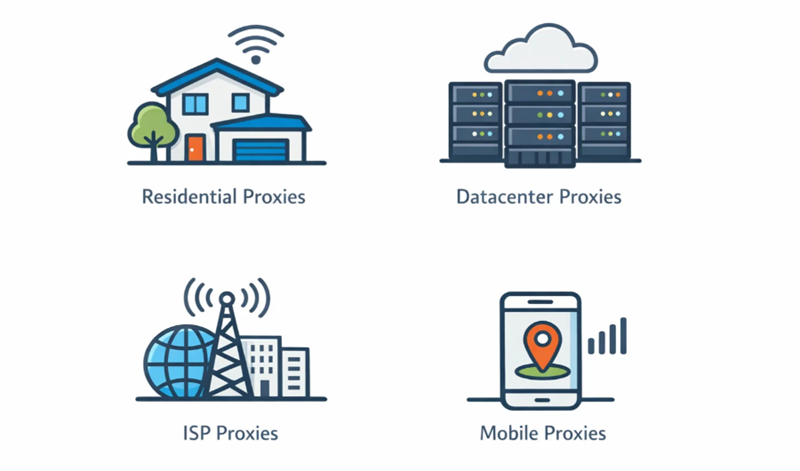
Decision Framework for 2026
- Low Budget + Unprotected Target: Utilizzo Centro dati proxies. There is no reason to pay for high-trust IPs when the target site has no meaningful bot protection.
- Large-Scale Scraping (Thousands of URLs, Protected Sites): Utilizzo Residenziale proxies. The rotating pool of millions of IPs ensures you never hit a hard rate limit, and the high trust score bypasses most anti-bot systems.
- Long-Term Account Management: Utilizzo ISP (Static Residential) proxies. You need a consistent, trusted identity that persists across sessions — rotating IPs will trigger “unusual activity” alerts on most platforms.
- High-Security Targets or Account Creation: Utilizzo Mobile proxies. When everything else is blocked, the CGNAT-backed trust of mobile IPs will get through even the most aggressive detection systems.
Use Case Recommendations
| Your Task | Recommended Proxy Type | Why? |
|---|---|---|
| Amazon / E-commerce Data Scraping | Residential (Premium) | High rotation and high trust score to bypass sophisticated bot detection on major retail sites. |
| Sneaker Botting | Residential or ISP | ISP for speed and stability at drop time; Residential for bulk raffle entries requiring diverse IPs. |
| Social Media Account Management | ISP or Mobile | Requires a static, high-trust IP to avoid triggering platform “suspicious login” detection. |
| Bulk Google SEO Queries | Residenziale | Google is highly aggressive toward datacenter subnets; residential IPs are essential for reliable SERP scraping. |
| Web Stress Testing (Own Servers) | Centro dati | Maximum bandwidth at the lowest cost — you control the target, so detection risk is irrelevant. |
| TikTok / Instagram Account Automation | Mobile | These platforms use advanced device fingerprinting; mobile IPs are the only type that passes consistently. |
| Verifica degli annunci | Residenziale | Granular city-level geo-targeting lets you verify how ads appear to real users in specific locations. |
| Login-Based / Authenticated Scraping | ISP | Session persistence is essential; a rotating residential IP will break authenticated sessions. |
How OkeyProxy Optimizes Your Workflow
Finding a reliable provider is just as important as choosing the right proxy type. While many providers focus on a single niche, OkeyProxy specializes in the three most critical categories for developers and businesses: Residenziale, Centro dati, e Proxy ISP.
Why choose OkeyProxy for your next project?
- Massive Residential Pool: Access 150M+ real residential IPs across 200+ countries. Dynamic rotation ensures your scrapers never encounter a hard block.
- High-Performance ISP Proxies: Static residential IPs that combine datacenter-grade speed with a genuine residential reputation — perfect for managing eBay, Amazon Seller Central, or social media accounts.
- Enterprise Datacenter Solutions: For internal testing or low-security scraping, OkeyProxy’s datacenter IPs deliver 99.67% uptime and < 0.3s rapid response.
Domande frequenti
What is the main difference between residential and datacenter proxies?
The core difference is the source of the IP address. Datacenter proxies use IPs assigned to commercial servers in cloud facilities (AWS, Google Cloud, etc.), making them fast and cheap but easily identifiable as non-human traffic. Residential proxies use IPs assigned by ISPs to real homes, making them appear as legitimate user traffic and far harder to block — at a higher cost.
What is an ISP proxy and how does it differ from a residential proxy?
An ISP proxy (also called a static residential proxy) is a hybrid: it is hosted on a datacenter server for speed and stability, but its IP address is registered under a residential ISP’s ASN. This gives it the trust profile of a residential IP with the performance of a datacenter proxy. Unlike standard residential proxies, ISP proxies are typically static — the IP address does not change between sessions.
When should I use mobile proxies instead of residential proxies?
Use mobile proxies when residential proxies are no longer sufficient. This typically happens when you are managing accounts on platforms with aggressive device fingerprinting (TikTok, Instagram), accessing high-security services (financial platforms, crypto exchanges), or when your residential IPs keep getting challenged by CAPTCHAs. Mobile proxies are the most expensive option and should be reserved for high-value tasks where their superior trust score is essential.
Are residential proxies always better than datacenter proxies?
No. For tasks targeting unprotected sites — public databases, simple HTTP sites, or your own servers — datacenter proxies offer superior speed and cost efficiency. Residential proxies are the better choice only when the target site has meaningful anti-bot protection. Using premium residential IPs for low-security targets is simply wasting budget.
Final thought
Understanding the difference between residential, datacenter, ISP, and mobile proxies is the foundation of any successful data collection or account management operation. If speed and cost are your primary concerns on unprotected targets, datacenter proxies are the right tool. For large-scale scraping of protected sites, residential proxies deliver the trust and rotation you need. For high-value, session-persistent workflows, ISP proxies offer an unbeatable combination of speed and stability. And for the most challenging environments — advanced fingerprinting, strict account platforms, or situations where every other option has failed — mobile proxies are the definitive solution.
In 2026, success in automation doesn’t come from having the best code alone; it comes from having the right IP reputation. The wrong proxy type at the wrong moment means blocked requests, burned IPs, and terminated accounts. By matching your proxy type to your specific task and choosing a high-quality provider like OkeyProxy, you can build operations that are efficient, resilient, and genuinely scalable.